

Francesc Català-Roca, or how to document with exquisite composition.
- Dartbooks

- 1 day ago
- 7 min read
Francesc Català-Roca occupies a fundamental place in the history of 20th-century Spanish photography. His work is deeply linked to the transformation of Spanish society in the decades following the Civil War, but to reduce him to the mere figure of a documentary photographer would be an oversimplification. Català-Roca possessed an immense visual culture, capable of moving with ease from reportage to portraiture, architecture, landscape, travel, and book photography, all while maintaining a personal and recognizable perspective. His lens observed a Spain in flux, but he also developed a singular view of this reality: with attentiveness, irony, a keen sense of composition, and an extraordinary ability to unearth striking images in seemingly insignificant situations.
Born in Valls in 1922, Francesc Català-Roca was immersed in photography from a very young age. His father, Pere Català i Pic, was one of the most important Catalan photographers of the first half of the 20th century and an emblematic figure of the photographic avant-garde and graphic experimentation. Francesc learned the fundamentals of the craft early on and began working within the family circle. This early training is essential to understanding his later development, because Català-Roca was not a photographer who discovered documentary photography by chance, but rather a man who perfectly mastered the photographic language and decided to use it to observe reality from his own perspective.

The Spanish Civil War abruptly interrupted this cultural climate and profoundly marked the lives of an entire generation. Català-Roca lived through this period while still very young and subsequently had to develop his professional career during the early years of the Franco dictatorship. In this context, he began working in various fields of photography, from press and advertising to editorial and commercial commissions. Gradually, he built an independent career that would make him one of the greatest Spanish photographers of his generation.
In 1947, he opened his own studio in Barcelona. From then on, he worked for magazines and publications, producing photojournalistic assignments that allowed him to travel throughout Spain and observe a society still marked by poverty and the aftermath of the war. But his photographic style possesses a fascinating peculiarity. Català-Roca didn't need to resort to extraordinary events to create a beautiful photograph. An ordinary street, children playing, a couple strolling, a group of workers, a shadow cast on a wall, or a person waiting on a street corner could be transformed into images of extraordinary visual power.
His photography possesses a characteristic I consider fundamental: it appears spontaneous, but behind this spontaneity lies an extraordinary sense of composition. Català-Roca knew how to wait for the precise moment. He knew how to position himself where he wanted and, above all, he knew how to recognize when an everyday scene could become a photograph. Many of his images also contain a humorous or ironic dimension that prevents his work from being reduced to mere documentary. One perceives an intelligence in his gaze upon what unfolds before the lens.
The Barcelona he photographed during those years is undoubtedly one of the finest examples of his talent. His images reveal a city still recognizable in many of its traditional aspects, yet simultaneously undergoing profound transformation. The streets, shops, workers, children, tourists, buildings, cars, and new forms of leisure compose a vast urban landscape that Català-Roca constantly observed. His aim was not to create an exhaustive portrait of Barcelona, but to capture small fragments capable of revealing something of the city and its inhabitants.
His Spanish photography exhibits a similar characteristic. Català-Roca traveled through numerous towns and villages and, through thousands of images, constructed a kind of fragmented portrait of contemporary Spain. But his photographs do not serve as illustrations for a political discourse. They do not need to dictate to the viewer what to think. Reality presents itself to us with all its contradictions: poverty and prosperity, tradition and modernity, religiosity and leisure, countryside and big cities, isolation and new forms of mobility. Català-Roca observes all of this without transforming his photography into an explicit denunciation.
This is precisely why it is difficult to categorize him entirely within a specific photographic movement. His work shares certain principles with neorealism, notably an interest in the everyday and anonymous, but his photography possesses a distinct personality. Composition, humor, geometry, and the relationship between subjects and space are of paramount importance. In many of his images, one also perceives a subtle and unintentional staging: people appearing in the right place, architectural elements establishing unexpected visual connections, shadows structuring a scene, or coincidences that seem orchestrated by the photographer, even though they originate from reality.
Another remarkable aspect of Català-Roca's work lies in his relationship to architecture. For decades, he photographed buildings, cities, and architectural spaces, collaborating with some of Spain's most important architects. His architectural photographs demonstrate that he did not consider buildings as mere isolated objects. He was interested in how architecture integrated into its environment and, above all, how people occupied these spaces. Human presence could lend scale, movement, and meaning to a building that, photographed in a purely technical manner, would have appeared quite different.
This connection to architecture also led him to collaborate closely with publications and editorial projects. This is one of the keys to understanding Català-Roca's importance in the field of the photobook. A considerable portion of his work was conceived specifically for publication. He worked on publications dedicated to cities, architecture, heritage, art, travel, and culture, and collaborated with writers, architects, artists, and publishers. Often, the book was not simply a collection of photographs. The editorial project itself determined the subjects to be photographed, the places to be explored, and how to visually construct a particular territory or theme.
This is why Català-Roca's bibliography is so important. His works allow us to trace a fundamental part of the evolution of Spanish photography during the second half of the 20th century. These publications lie at the intersection of photography, literature, architecture, history, and visual culture. To study Català-Roca, it is not enough to consider his photographs individually. It is also necessary to observe how they were used, organized, and published.

His collaboration with writers was particularly fruitful. Català-Roca's photographs appeared in numerous projects where image and text interacted. This contributed to creating a specific visual representation of Spain and Catalonia at a time when the country was gradually opening up to the world. The photographer thus became a kind of visual intermediary between the territory and the reader.
He also photographed some of the greatest Spanish artists and intellectuals of his time. His portraits of Joan Miró, Salvador Dalí, Antoni Tàpies, and other cultural figures constitute a visual record of paramount importance. But here again, Català-Roca doesn't seem content simply to capture the face of a personality. He seeks the gesture, the space, the object, or the situation that allows him to construct an image imbued with its own distinct character. His portraits often possess a circumstantial dimension, as if the photographer had encountered his subject at a specific moment in their life, and not merely in front of a backdrop prepared for a formal photograph.
This ability to transform a commissioned work into a personal photograph is one of the characteristics that explains his immense versatility. Català-Roca could work for a magazine, a publishing house, an architect, or an institution while maintaining a perfectly recognizable vision. He didn't need to work on a project considered artistic for his personality as a photographer to shine through.
His work outside of Spain is also noteworthy. His travels through various countries, particularly in Latin America, significantly broadened his perspective. Mexico, Peru, and Bolivia, among others, feature in his photographic work related to cultural and editorial projects. Here again, he applied a perspective that went beyond simply documenting monuments or tourist sites. He was interested in people, markets, traditions, urban spaces, objects, and the relationship between the old and the new.
These works also reveal another facet that deserves far greater attention than it has traditionally received: color. When we think of Català-Roca, we immediately think of the black and white of his photographs of Barcelona and postwar Spain. Yet, his use of color demonstrates that his photographic language was not dependent on any particular aesthetic. Color allowed him to explore new relationships between people, objects, architecture, and landscape, particularly in his work outside of Spain.
Throughout his career, Català-Roca maintained close ties with cinema and other areas of visual culture. This diversity of interests allows us to better understand his photography. He was not a photographer confined to a single discipline. His vision was nourished by architecture, design, cinema, literature, art, and, of course, the photographic tradition itself.
But perhaps the best way to grasp his significance is to observe the Spain he immortalized through his lens. Català-Roca photographed a society in transition, moving from a still deeply rural and traditional Spain to a much more urban and modern one. The streets filled with cars, new forms of consumption emerged, tourism developed, cities were transformed, and new leisure activities arose. This entire process is evident in his photographs, often without the photographer needing to explain it.
And this is one of the great qualities of her work: Català-Roca documents without reducing her photographs to mere documents. Her images possess a formal force sufficient to transcend the context of their creation. We often don't know the identity of the person photographed or the exact location where the photograph was taken, and yet the photograph continues to resonate within us. A particular posture, a shadow, a glance, a visual coincidence, or an unexpected composition is enough to keep the image alive.
Català-Roca died in Barcelona in 1998, after more than fifty years dedicated to photography. He left behind an immense and extraordinarily diverse body of work. But his true importance lies not only in the quantity of photographs he took, but also in his decisive contribution to transforming the way everyday life was perceived in Spain.
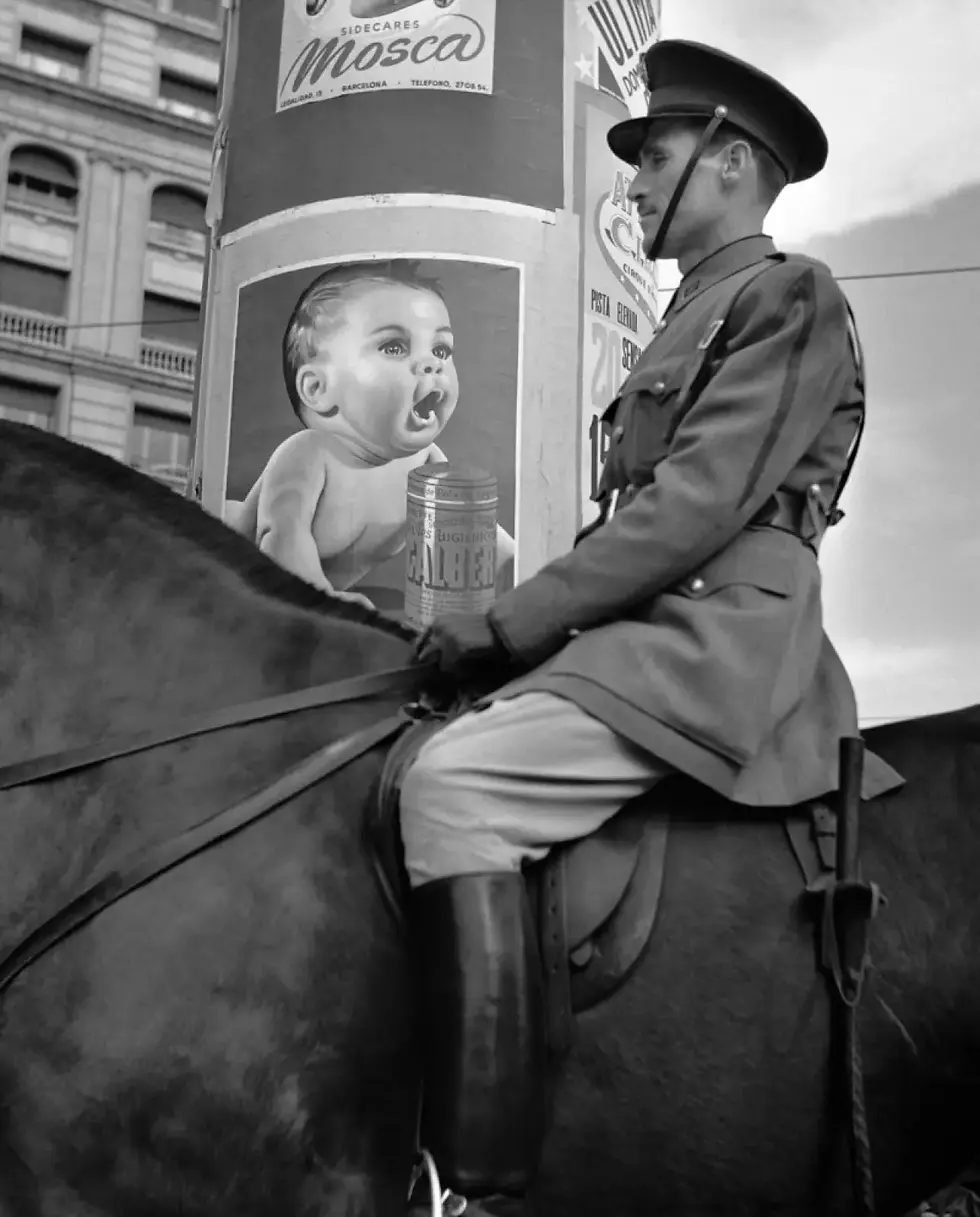
For a long time, Spanish photography had to contend with a tradition excessively constrained by pictorialism, academicism, and the country's political context. Català-Roca helped to refocus this gaze on the street, on people, on everyday life, on what was happening right before our eyes and which, precisely because it was so commonplace, could easily go unnoticed.
And I believe that's why his work remains so important today. Català-Roca didn't need to invent an extraordinary reality. He simply needed to learn to perceive the reality around him in an extraordinary way.
From Dartbooks' perspective, Català-Roca is particularly interesting because his work allows us to study an essential part of the history of the Spanish photography book. His publications are not simply a complement to his photographic career, but rather a field in which his vision developed most profoundly. Through his books, we can follow the evolution of Spain, Barcelona, architecture, and Spanish photography itself over several decades.
And perhaps that is precisely why he deserves to be rediscovered today, not only as one of Spain's greatest documentary photographers, but also as one of our country's greatest authors of photography books. His work demonstrates that a photography book can be simultaneously document, narrative, memory, and visual creation. And that a seemingly simple photograph, when the product of a truly intelligent eye, can become an image capable of transcending generations.



Comments