

Photobook Market
- Dartbooks

- 2 hours ago
- 8 min read
In the fascinating world of photobook collecting, there is a specific terminology that allows for the precise description of a book's characteristics. These terms help determine aspects such as its provenance, uniqueness, and bibliographical importance, and in many cases, can have a considerable impact on its value.
In this post we're going to review some of these terms and details, because certain aspects can radically change the price of a photobook, both upwards and downwards.
Signed by the author
A signed photobook is one that contains the photographer's own handwritten signature, usually located on the cover, the title page or one of the first pages, without any personalized text addressed to a specific person.
The author's signature typically increases the interest and value of a photobook significantly. However, not all signatures carry the same weight. Factors such as authenticity, the era in which the photo was taken, the location where it was signed, and the photographer's reputation can all have a considerable influence. In any case, all other things being equal, a signed copy is usually worth more than an identical copy without a signature.
Inscribed or dedicated by the author
We refer to a book as inscribed when the photographer, in addition to signing the book, writes a personal message addressed to a specific person. This could be a simple dedication, a greeting, a phrase, a quote, or even a small hand-drawn sketch.
Here we find an important difference compared to a simple signature. A personalized dedication can add enormous documentary and sentimental value, but it doesn't necessarily increase the book's commercial value.
For example, an inscription like "To John, with appreciation" makes the book unique, but if the person who buys it isn't John, that personalization can limit its appeal to other buyers. For this reason, in certain circumstances, a simply signed copy can be more commercially desirable than one dedicated to an unknown person.
Copy of association
A commemorative copy is a copy signed or dedicated by the author to a person who has a particularly significant relationship with him, with the work, or with the historical, artistic, or cultural context in which it was created.
This is where a simple dedication can acquire extraordinary importance. If, for example, a photographer dedicates a book to another photographer, an editor, a gallery owner, a writer, or someone closely related to the project, the inscription ceases to be a simple personal dedication and becomes a piece of historical information about the work itself.
We recently came across a particularly curious case in a copy of The Straw Hat Cat by Masahisa Fukase. In addition to Fukase's own signature, the copy also contained the paw print of his beloved cat, Momoe.
Such a unique feature transforms the copy into something much more than a signed book. It becomes an exceptional copy, with a characteristic that can hardly be replicated in another copy.
And here we see one of the simplest rules of collecting: when the supply is reduced to a single copy and there is high demand, the price can reach extraordinary levels.
Ultimately, in the world of photobooks, seemingly minor details can completely transform the nature and appeal of a copy. A signature, a dedication, exceptional provenance, or a unique feature can turn an ordinary book into a truly extraordinary piece.

First edition
In the world of photobook collecting, "first edition" doesn't always mean exactly the same thing as "first printing." Although the two concepts are closely related, it's important to distinguish between them, especially when trying to determine the earliest copy of a publication.
The first edition refers to the first published version of a work. Within that edition, there may be different printings or runs. Therefore, when we look for the copy closest to the original publication date, we are usually interested in locating the first printing of the first edition.
Let's look at a simple example.
Imagine a publisher releasing a photobook with an initial print run of 500 copies. All 500 sell out, and due to demand, the publisher decides to print another 500 copies with exactly the same characteristics, without modifying the content, design, layout, or any other element of the publication.
In this case, the new copies still belong to the first edition, but they correspond to a second printing or second run.
Therefore, we might encounter:
First Edition, First Printing
and
First Edition, Second Printing
Both belong to the first edition, but the first printing is the one that corresponds to the initial print run.
Now, what happens if the editor decides to introduce some changes?
This is where things get more interesting. If the edition is modified in any way between print runs, even if it's a seemingly small change, we're no longer simply talking about a reprint of the same edition, but a new edition altogether.
Therefore, in photobook collecting, it is essential to pay attention to all the bibliographic and physical details of a copy. A change in the content, design, layout, text, or certain editorial characteristics can be enough to distinguish one edition from another.
First edition Thus
The term First Edition Thus can be especially confusing, particularly for those just beginning to familiarize themselves with collector's book terminology.
The word "thus" literally means "in this way" or "in this form." Therefore, First Edition Thus can be understood as "first edition in this form."
The expression does not indicate that we are dealing with the first historical edition of a work. It is used to point out that this is the first time that the work has been published under certain characteristics, format, or editorial configuration.
A very simple example would be a photobook originally published in paperback format. If a hardcover edition is subsequently released for the first time, this new publication can be described as a First Edition.
The work had obviously been published before. What is new is the way it is presented.
Therefore, we might come across a publication that is:
First Edition: the first historical edition of the work.
First Edition Thus: first edition of that work in a particular configuration or format.
This distinction is especially useful in photobooks, where changes in format, design, binding, language, image selection or editorial characteristics can result in publications that, although based on the same work, have a different bibliographic consideration.
In short, when we encounter the expression "First Edition Thus," we shouldn't interpret it simply as "first edition." The "thus" is precisely what indicates that it is the first edition of the work in a new format or editorial presentation.

The image above shows the first edition of A1 The Great North Road, one of Paul Graham's most important works. The book was published in 1983 by Grey Editions in its original paperback format.
In the image below we find a much later publication: the First Edition Thus published by Mack Books in 2020. In this case, the work appears for the first time in this new editorial configuration in hardcover or cardboard format, for those who prefer the more purist terminology.
Although both publications contain the same photographic project by Paul Graham, they should not be confused bibliographically. The 1983 Grey Editions edition is the first historical edition of the work, while the 2020 Mack Books publication is a First Edition Thus, that is, the first edition of A1 The Great North Road presented in this new editorial format.
A good example, therefore, of how the same work can appear decades later in a completely different format without that new publication being considered the first original edition of the photobook.
Obi / Bellyband
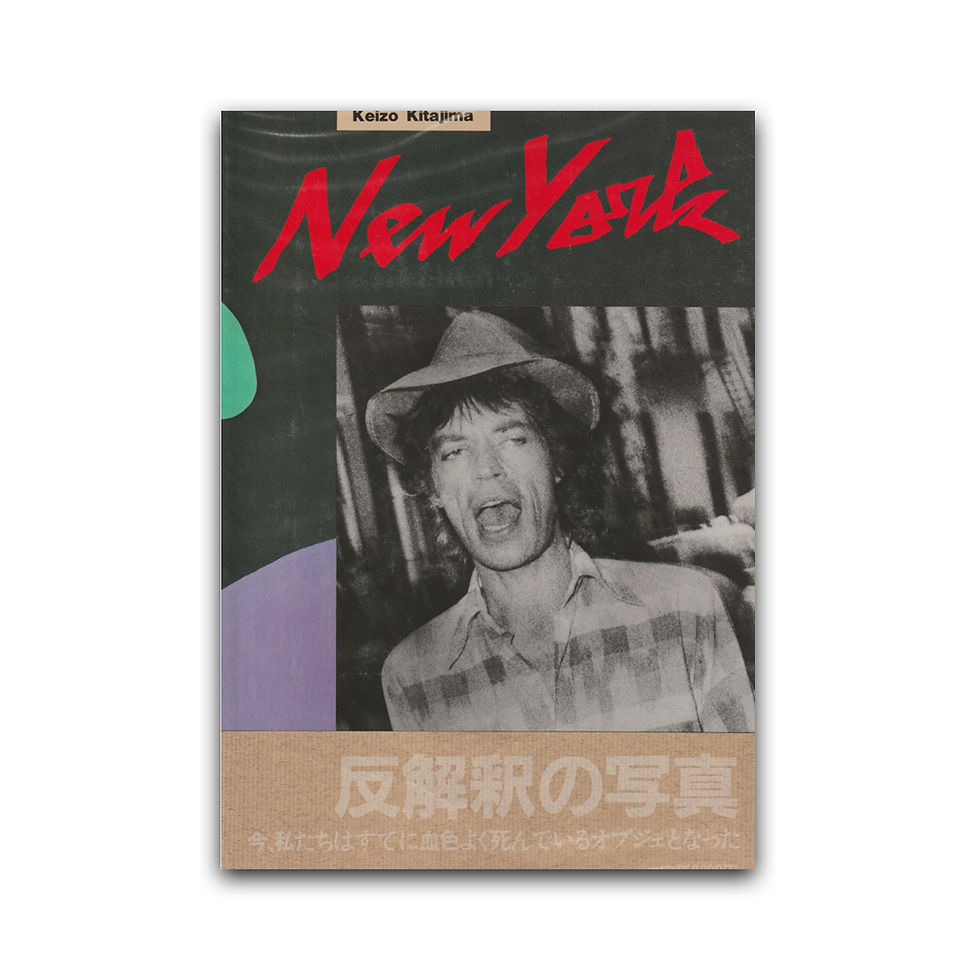
The obi, also known as a "belly band" in English-speaking countries or simply as a "sash" in some regions, is a narrow strip of paper that traditionally encircles the cover of many Japanese books. Its name comes from the Japanese word 帯, which literally means "belt" or "sash," referring to the way it wraps around the book.
In Japanese photobooks, the obi primarily serves an editorial and promotional function. It may include the title of the work, information about the photographer, promotional texts, reviews, awards received, or any other message the publisher deems relevant for presenting the book to the public. In some cases, it may even contain information not found anywhere else in the publication.
But the obi is much more than just an advertising element.
Within the collection of Japanese photobooks, preserving the original obi can be especially important because it forms part of the book's original presentation and marketing. A copy that retains its obi can preserve information that disappears when the obi is lost: how the book was presented, what message the publisher used to promote it, or what events surrounded its publication.
Furthermore, obi sashes are extremely fragile. They are usually made of thin paper and protrude from the cover, so they deteriorate, tear, or are simply lost very easily. For this reason, finding an old Japanese photobook with its obi sash can be considerably more difficult than finding the same book without it.
For a collector of Japanese photobooks, the obi can make a significant difference between copies. It's not the same to find a book without an obi, one with a later obi, or one that still has the obi it was originally published with.
In short, the obi may seem like a small, secondary element, but in Japanese photobooks it has enormous historical and bibliographical importance. It is part of the book's original presentation, provides information about its publishing context, and, due to its extreme fragility, many copies have survived to this day without it.
That's precisely why, when we find a Japanese photobook that still has its original obi, we're not simply looking at a book with a paper band around the cover. We're looking at a copy that has preserved a part of its physical history.
The fact that a book lacks the original obi with which it was launched on the market is a characteristic that considerably reduces its price, sometimes even by half its price with obi, since for most collectors it is no longer a complete copy of the book.
Copy altered by the author
An author-modified copy is a copy of a photobook in which the photographer has made physical or artistic modifications to the book after its publication.
These interventions can take many different forms: adding drawings, handwritten notes, original photographs, collages, paint, stamps, cross-outs, texts, cutouts or any other element made directly by the author.
The fundamental difference with respect to a signed or dedicated copy is that, in a signed copy, the photographer's intervention is normally limited to their signature, while in an altered copy the author physically modifies or expands the content or appearance of the book.
These types of copies can be especially important because each intervention can transform the book into a unique piece. Even when several copies belong to the same edition, a different intervention by the photographer gives each copy its own characteristics.
In some cases, these copies may be expressly made by the author as unique works or as a small series of altered copies. When the alteration is directly related to the photographic project, it can also establish a particularly interesting connection between the published book and the photographer's artistic practice.
Therefore, within the world of photobook collecting, it is important to distinguish between:
Signed book: contains only the author's signature.
Inscribed or dedicated book: contains a signature accompanied by a personal message.
Altered copy: the author physically modifies the copy through an artistic or conceptual intervention.
The altered copy is therefore in an intermediate territory between the photobook and the unique work of art, and its interest will depend especially on the nature of the intervention, its authenticity, its relationship with the project and the importance of the photographer.

Here we can see the great Txema Salvans working on some copies of his latest photobook, “Sunday Morning,” published by RM.

Comments