

Hiromix and his transgressive photographic vision.

Hiromix, whose real name is Hiromi Toshikawa, was born in Tokyo in 1976 and became one of the most unique figures in Japanese photography of the 1990s. Her emergence was especially significant because she entered the professional world at a very young age and because her photographic style broke with much of the Japanese photographic tradition of previous decades. Instead of seeking a solemn, formal, or intellectually elaborate photograph, Hiromix transformed her own daily life into photographic material. Friends, self-portraits, animals, flowers, objects, music, rooms, nights in Tokyo, and small personal events appear mixed together in a kind of visual diary that ended up becoming one of the most recognizable expressions of Japanese youth of that era.

Her entry into the world of photography came in 1995, when she was 18. She submitted a project titled Seventeen Girl Days to Canon's New Cosmos of Photography competition and won the Grand Prize. The work had been done when she was 17 and consisted of photographs of her life as a high school student. What was extraordinary was not only the photographer's age, but the freedom with which she had constructed the project. She didn't seem to be trying to demonstrate that she knew how to take technically sophisticated photographs. Her interest lay in recording what was part of her own experience: her friends, her personal belongings, the music, her moods, her self-portraits, and the feeling of growing up and approaching adulthood.
Nobuyoshi Araki played a decisive role in that beginning. He was the one who nominated her for the competition and was part of the jury that immediately recognized the uniqueness of her work. Araki saw in those photographs an attitude that he found particularly interesting: an intuitive way of working, unconcerned with rules and based on the immediate reaction to what was in front of her. Fumio Nanjo, another member of the jury, also highlighted the combination of naiveté, fragility, and a certain darkness that he found in Hiromix's work.
It's important to understand that Seventeen Girl Days wasn't simply a teenager's photographic diary. In the context of 1990s Japanese photography, it represented a shift in attitude. The camera was no longer necessarily a tool for constructing a formal photographic work and could become an extension of everyday life. Hiromix photographed because she wanted to preserve a particular feeling of the present. Photography didn't have to explain an external reality. It could serve to understand one's own identity.

In 1996 , her first major photobook, Girls Blue , was published . It is one of the essential books for understanding Japanese photography of the 1990s and also one of the titles that best represents the birth of a new photographic sensibility among young Japanese women. Many of the photographs were taken with a small compact camera, a Konica Big Mini, and show Hiromix and her friends during their outings in Tokyo. The book conveys the energy of a youth living amidst music, friendship, nightlife, popular culture, and a growing self-awareness.
One of the most interesting features of Girls Blue is that the images appear spontaneous, but the book's construction reveals a very conscious selection process behind that spontaneity. Hiromix had taken a vast number of photographs and subsequently chose those that best represented a particular experience of youth. The result is not simply a family album or a private diary. It is the transformation of a personal experience into a visual narrative that can resonate with others.
Herein lies one of the major debates surrounding Hiromix. Her photography was quickly associated with what later became known as "girly photography ," a movement or sensibility linked to young Japanese female photographers who used compact cameras and explored themes such as friendship, the body, identity, daily life, and personal relationships. Alongside Hiromix, names like Yurie Nagashima and Mika Ninagawa are often mentioned, although each developed a very different career path and aesthetic.
The label "girly photography" is useful for understanding the context, but it can also be overly reductive. The problem is that many of these photographers were initially interpreted through the lens of their status as young women rather than through the complexity of their work. Hiromix's photography was celebrated for its freshness and spontaneity, but it was also quickly absorbed by fashion culture, magazines, and advertising. Her image as a young photographer became part of the phenomenon she herself had helped to create.
That process was remarkably fast. Shortly after finishing high school, Hiromix was already working professionally and began receiving editorial commissions. The music magazine Rockin' On played a particularly important role in those early years, allowing her to photograph Japanese and international musicians. She went on to work with artists such as the Beastie Boys, Sean Lennon, and Marilyn Manson, among many others. Music photography, fashion, and youth culture were all part of the same universe for her, which also explains why her career developed far beyond the strictly artistic circuit.
In 1997, he published other works, including Japanese Beauty , and his name began to acquire an international dimension. In 1998, Hiromix was published , edited by the French critic Patrick Remy and released by Steidl. This edition was especially important because it brought his work to a European audience and helped consolidate his position within international contemporary photography. The fact that a publisher like Steidl released his work also helped shift the perception of Hiromix from the realm of Japanese youth photography to the territory of the auteur photobook.
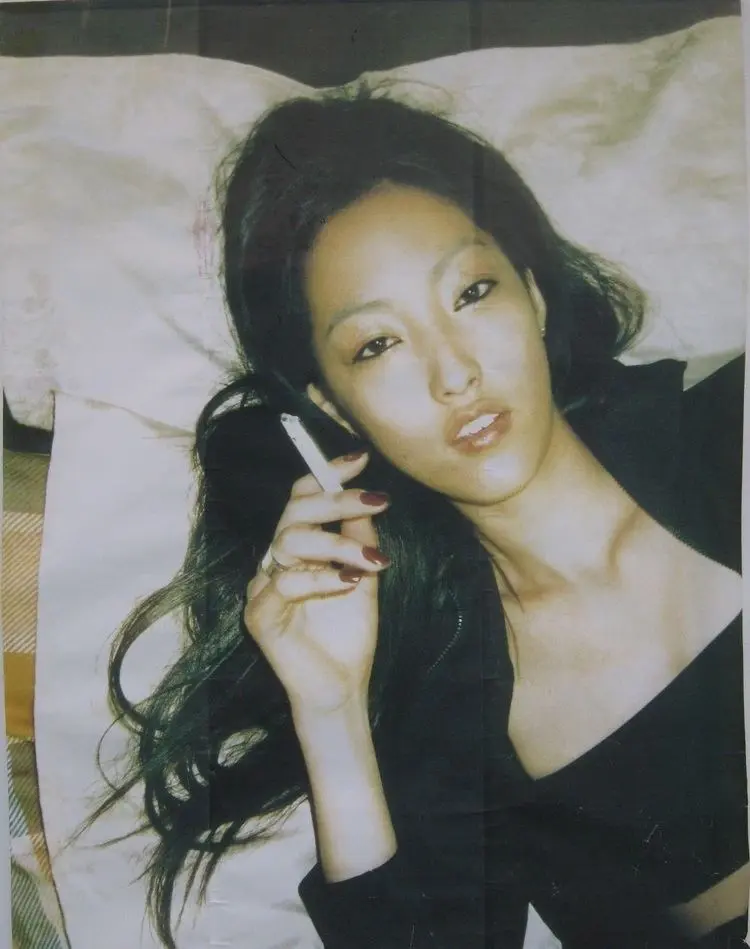
This same period coincided with a surge of international interest in new Japanese photography. The 1990s saw a profound renewal of the medium, and photographers like Daido Moriyama, Nobuyoshi Araki, Takashi Homma, Masahisa Fukase, and Rinko Kawauchi were beginning to receive much greater attention outside of Japan. Hiromix brought something different: a perspective born directly from contemporary youth culture and everyday photography.
In 2000, he received the Kimura Ihei Award for Hiromix Works . This was a particularly significant recognition because the Kimura Ihei Award is one of the most prestigious accolades in Japanese photography. The award confirmed that his seemingly informal and youthful aesthetic had acquired much greater relevance. It was no longer simply a fad associated with compact cameras and youth magazines. Hiromix had managed to enter the canon of contemporary Japanese photography.
However, her enormous popularity also had a problematic side. Her youth, her appearance, and the image of the teenage photographer documenting her own life became part of her public persona. The Hiromix character began to acquire a commercial and media dimension that could be difficult to separate from the photographer. The publishing and advertising industries found in her a perfect figure to represent a new idea of Japanese youth: independent, modern, urban, feminine, and connected to music and fashion.
This transformation is particularly interesting because there is a contradiction between the origin of her photographs and the way they were received. Hiromix had begun photographing for herself, trying to record her own experience, but success turned that intimacy into a cultural product. What could originally be understood as a form of personal expression ended up being used to represent an entire generation.
Hiromix herself reacted on several occasions against the way her first photograph was interpreted. She didn't want to be reduced to the idea of "cute" or simply adorable. Her first images had been enthusiastically received precisely because of that spontaneous, youthful, and attractive appearance, but she wanted to prove that she could do something different. From then on, she began to modify her working methods and explore a type of photography less directly related to the image of the teenager that had defined her early years.
His relationship with music was also much deeper than it might seem. Hiromix didn't just photograph musicians. He was part of the Japanese music scene and developed his own sound-related projects. He released music, worked as a DJ, and collaborated on various audiovisual projects. Music, therefore, wasn't simply a subject he photographed, but a real part of his cultural environment.
She also experimented with film, video, fashion, and advertising. She produced audiovisual works and participated in projects related to moving images. In 2003, she made a brief appearance in Sofia Coppola's film * Lost in Translation *, and her presence helped to reflect the connection that existed between Tokyo's artistic, musical, and youth culture at that time.
Another interesting aspect is her relationship with Wolfgang Tillmans. The German photographer portrayed her in 1997, at a time when both, from very different cultural contexts, represented a new way of understanding photography related to youth, intimacy, music, and everyday life. Tillmans was also questioning the traditional separation between documentary photography, personal photography, fashion, and popular culture. The convergence between them is quite revealing.
The comparison with Nan Goldin is also inevitable, although their worlds are very different. Goldin had transformed her circle of friends and her own life into photographic material, demonstrating that intimate experience could become an artistic document of enormous power. Hiromix shares this use of the camera as a personal diary, but her world is much more closely linked to Japanese adolescence, music, popular culture, humor, and the feeling of discovery. There is an emotional intensity in her photographs, but they typically lack Goldin's dark drama.
A comparison can also be drawn with Larry Clark. Both photograph from within their own generation, not from the distance of an external observer. However, while Clark constructs a universe in Tulsa marked by drugs, sex, violence, and marginalization, Hiromix finds the subject matter of his work in much more ordinary situations. His photographs speak of the experience of being young, of being with friends, going out at night, listening to music, falling in love, getting bored, and gradually discovering who you are.
Hiromix's importance is also linked to photographic technology. The compact camera played a fundamental role in his early work. He didn't need sophisticated equipment to create his images. The ease of carrying a small camera allowed him to photograph virtually any moment. This way of working was closely connected to a new Japanese visual culture in which teenagers constantly produced photographs of themselves and their friends, especially through photo booths known as Purikura .
What's interesting is that Hiromix transformed this culture of everyday images into an artistic practice. The compact camera ceased to be merely a device for preserving memories and became a tool for constructing a visual identity. In this sense, his work anticipates many of the characteristics that would later become commonplace with digital photography and social media: constantly photographing one's own life, constructing an identity through images, and using photography as a form of interpersonal communication.
Her bibliography from the 1990s and early 2000s includes titles such as Girls Blue , Japanese Beauty , Hiromix , Hiromix Works , Hiromix Paris '97-'98, and Hiromix '01 . Each one showcases different moments in her evolution and allows us to see how she gradually moved away from the formula that had made her a celebrity.
From the perspective of photobooks, Girls Blue remains arguably the most important book for understanding Hiromix's origins. It is where her visual language emerges most naturally and where the relationship between photography, adolescence, and everyday life is most evident. Hiromix , published by Steidl in 1998, holds particular significance because it represents her definitive entry into the international photobook scene.
What makes Hiromix relevant today is not simply that she was a very young photographer who achieved enormous success during the 1990s. Her importance lies in having helped change the very definition of what artistic photography could be. A compact camera, a room, a friend, a night in Tokyo, or a self-portrait could all become sufficient material to create a work of art. There was no need to seek out an extraordinary event. Everyday experience itself could be the subject.
And perhaps that's the most interesting aspect of Hiromix. Her photographs document a specific era, but at the same time, they speak to something much more universal: the need to preserve a stage of life before it disappears. Adolescence appears in her images as a period of discovery, insecurity, and freedom, but also as something inevitably fleeting. The camera then becomes a way to stop time and preserve an identity that is constantly changing.



Comments