

Masahisa Fukase: the photographer turned crow

Masahisa Fukase was born on February 25, 1934, in Bifuka, a small town in Hokkaido, in the far north of Japan. He grew up in a family where photography was not just a hobby, but a profession. His father, Sukezō Fukase, ran the family photography studio, founded by previous generations, and it was there that young Masahisa learned the basics of photography, portraiture, and darkroom development at a very early age.
In 1952, he moved to Tokyo to study photography at Nihon University. Graduating in 1956, he began working as an advertising photographer, but quickly developed a much more personal style. In the 1960s, he published photographs in Japanese magazines and experimented with a photographic style blending autobiography, dark humor, absurdity, and a certain fascination with death.
In 1961, he presented his first solo exhibition, "Killing the Pig." This project combined photographs taken in a slaughterhouse with images from his private life, including photos of his partner and a stillborn child. From the outset, a characteristic that would accompany Fukase throughout his career was evident: the inability to completely separate personal experience from photography. For him, photography was not simply observing the world, but transforming his own existence into photographic material.

In 1963, he met Yoko Wanibe, whom he married in 1964. Yoko would become a central figure in his work. For years, Fukase photographed her obsessively, transforming their marriage into a kind of visual laboratory where love, intimacy, desire, dependence, and separation intertwine.
In 1971, his first major photographic work, Yūgi, also known as Homo Ludence, was published. Edited by Chūōkōron-sha, this book brings together images related to his personal life and his relationship with Yoko, and can be considered one of the first major examples of how Fukase would transform his own life into photographic art.
That same year, he began one of his most important and longest-running projects: "Family." Fukase regularly traveled from Tokyo to Bifuka and used his parents' photo studio to take portraits of his family. What initially seemed like a simple photographic game became the chronicle of a work spanning nearly twenty years. Family members change, age, disappear, and die before the lens. Fukase himself gradually appears in these images, transforming the family portrait into a reflection on the passage of time and loss.
In 1974, his work gained international renown thanks to his participation in the "New Japanese Photography" exhibition at the Museum of Modern Art in New York. Organized by John Szarkowski and Shōji Yamagishi, this exhibition introduced Western audiences to a new generation of Japanese photographers and placed Fukase alongside major figures of post-war Japanese photography.
But while his artistic fame grew, his marriage deteriorated. Fukase and Yoko divorced in 1976. Shortly after, one of the most significant chapters of his career began.
Yoko
In 1978, he published Yōko, published by Asahi Sonorama. This work serves both as an extension and a farewell to their relationship. Yoko appears photographed at different times and in different places, but the intimacy that emerges from these images is tinged with distance and loss.
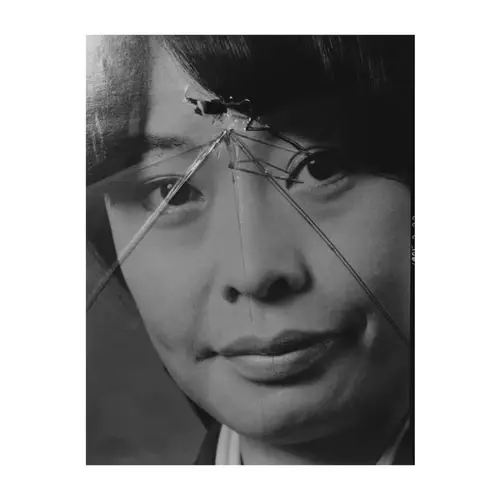
One of the most famous photographs in the book shows Yoko behind a shattered window. The image perfectly illustrates the transformation of their relationship: the one who, for years, had been the center of Fukase's attention now appears separated from him by a fragmented surface.
That same year, he also published Viva! Sasuke and Sasuke!! My Dear Cat, dedicated to his cats. Then came The Cat in the Straw Hat. Animals were much more than a secondary theme for Fukase: they allowed him to explore play, affection, and the absurd from a different angle than in his autobiographical works.

And then the crows appeared
In 1975, during a train journey from Tokyo to Hokkaido, Fukase began photographing crows. These early images would become the project that would make him a part of photographic history.
For the next ten years, he continued to photograph them in train stations, towns, along roads, in snowy landscapes, and on the coasts of Hokkaido. The crows appear as black specks against a grey sky, bare trees, snow, power lines, and almost deserted landscapes.
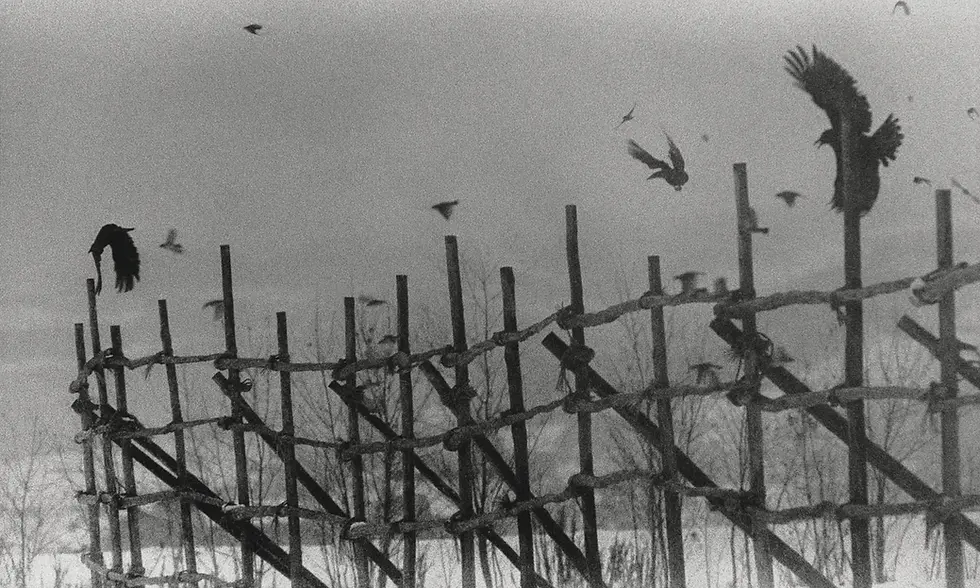
But it wasn't really a study about birds.
Fukase began to identify with them. After his divorce from Yoko, the crows gradually became a reflection of his own emotional state: loneliness, isolation, nostalgia, loss, and a feeling of being cut off from the world. In 1982, he even wrote that he had become a crow.
The project also had an experimental dimension. Fukase photographed the crows in black and white and in color, including a series of Polaroids taken in 1985 and known as "Crow Scenes".

In 1986, Karasu was finally published by Sōkyūsha in Tokyo. In the West, it would be known as Ravens or The Solitude of Crows. The book quickly became a seminal work of postwar Japanese photography.
Karasu is not a documentary book about crows. It is actually a disguised self-portrait. Fukase uses landscape, animals, and darkness to talk about himself. The crows are his double.
And that is perhaps why the English title "The Solitude of Ravens" is so powerful: the true protagonist of the book is not the raven, but solitude.
Family and memories of the father
While developing his Ravens project, Fukase continued to return to Bifuka and photograph his family.
The "The Family" project developed between 1971 and 1989. During these years, the family studio was transformed into a stage where family members regularly appeared on camera. What may initially have seemed like an absurd game gradually evolved into a meditation on aging and loss.
In 1985, Fukase resumed the project after a ten-year hiatus. His father had aged considerably by then. In 1987, Sukezō passed away. Fukase continued to photograph the consequences of this loss and presented "Memories of My Father" in 1988.
In 1989, the family photo studio closed its doors for good, and the family members went their separate ways. The place that had served as a backdrop for photographs for nearly twenty years disappeared.
In 1991, two major works were published: *Family* and *Memories of Father*. According to Fukase's archives, *Family* was his last book of photographs published during his lifetime. It brings together 31 portraits taken chronologically in the family studio and, in retrospect, has become a kind of tribute to a family that was gradually fading away.
Recent years: Private scenes
In the early 1990s, Fukase increasingly turned his camera towards himself.
Private Scenes, Hibi, and Berobero reveal another facet of Fukase: his walks through Tokyo, his visits to bars, his photographic self-portraits, his bodily experiments, and his play with the camera. He no longer seems interested in establishing a clear boundary between photographer, subject, and world.
In Bukubuku, she created a series of performative self-portraits in her bathtub. In Hibi, she obsessively photographed the streets, surfaces, signs, and fragments of the city. In Private Scenes, she transformed her daily commutes into a kind of visual diary.
In February 1992, he presented Private Scenes '92 at the Nikon Ginza trade fair and received the special prize at the Higashikawa Photography Awards the same year.
But a few months later, on June 20, 1992, a tragedy occurred that definitively ended his career.
Fukase fell down the stairs of his usual bar and suffered a severe head injury. He survived, but was left with permanent disabilities that prevented him from leading an independent life. He spent the next twenty years in a specialized institution.
He died on June 9, 2012, at the age of 78.
He was 78 years old and had not been able to practice his profession as a photographer for twenty years.



Comments