

Robert Frank and the paradigm shift of "The Americans"
- Dartbooks

- 2 hours ago
- 12 min read
On countless occasions I have seen a look of bewilderment appear on the face of someone who is beginning to take their first steps in the exciting world of photography and, by extension, photobooks.
How is it possible that these 83 photographs, many of them blurry, out of focus, underexposed, and with framing that seems to defy all the rules of photography, have ended up becoming one of the most influential photobooks in history?
Okay, let's take it one step at a time.
1947
Robert Frank, a 23-year-old Swiss photographer, arrives in the United States in 1947.
By then, Frank already had a solid photographic background acquired in Switzerland and had worked as a photographer in Europe. In New York, he began working for fashion magazines and publications, including Harper's Bazaar. However, he gradually began to feel uncomfortable with the limitations of commercial and editorial photography.
In the mid-1950s, Frank was looking for something different. He didn't want to simply produce attractive photographs or reinforce the image of America that magazines and the media projected at that time.
And this is where a key figure in his career appears: Walker Evans.
It has sometimes been suggested that Frank used his relationship with Evans to achieve his goals, but the truth is that Walker Evans' influence on Frank was much deeper. He didn't simply provide him with certain contacts or recommendations. Evans was a fundamental reference point in his understanding of photography: as a form of personal, rigorous, and deeply conscious observation of reality.
Among other recommendations, Evans's helped Frank obtain a John Simon Guggenheim Fellowship in 1955.
The scholarship would be crucial.
For the first time, Frank had something extraordinarily valuable for a photographer: time and freedom to work without being constrained by the demands of a commercial commission.
His proposal essentially consisted of traveling across the United States and creating a photographic portrait of American society. He didn't want to limit himself to photographing its grand monuments, landscapes, or national symbols. He wanted to observe how Americans actually lived and, above all, what lay behind the country's official image.
And here begins the real adventure of The Americans.
1955-1956
Frank began traveling across the United States in 1955 and continued working on the project for approximately two years. He departed from New York and made numerous trips before embarking on a much longer journey west.
He drove thousands of miles, passing through large cities, small towns, and rural areas. He went through places like Detroit, Savannah, Miami Beach, New Orleans, Houston, Los Angeles, Reno, Salt Lake City, Butte, and Chicago, among many others.
During the project, he took approximately 27,000 or 28,000 photographs, depending on the source and the method used to count the negatives. From this immense archive, he would eventually select only 83 photographs.
The proportion is brutally small.
And this fact is fundamental to understanding The Americans. We are not simply looking at the result of a photographer who traveled across the United States and later selected some of his best photographs.
Frank was writing a book.
He wasn't trying to prove he could take good photographs on his own. What he was trying to construct was a particular vision of the United States through the relationship between one image and another.
The trip wasn't a particularly comfortable experience either.
Frank was European, Jewish, and a foreigner. His perspective clashed with the patriotic, optimistic, and triumphalist vision of Eisenhower's America. In some parts of the South, he ran into trouble with the authorities. In Arkansas, he was arrested and imprisoned for a time, and on another occasion, a sheriff ordered him to leave a town.
These experiences further reinforced his outsider status.
Frank wasn't photographing the United States as someone fully integrated into American society. He was doing so as a foreigner who had chosen that country to live in, but who still maintained the necessary distance to observe it from the outside.
And that distance would eventually become one of the essential characteristics of The Americans.
What was he actually photographing?
Here we find one of the great differences between Frank and much of the earlier American documentary tradition.
The United States was experiencing a period of enormous economic prosperity. It was the America of automobiles, household appliances, highways, television, advertising, families, and consumerism.
The official photograph could present all of that as the story of a prosperous and successful society.
Frank decided to look the other way.
He photographed bars, highways, gas stations, restaurants, cars, parades, workers, couples, families, politicians, anonymous citizens, black and white people, rich and poor, churches, cemeteries, parties, jukeboxes, motels, and seemingly insignificant spaces.
But what was truly revolutionary was not only what he photographed.
That's how he photographed him.
His photographs often appeared out of focus.
He used slow shutter speeds.
It allowed the grain to become part of the image.
It tilted the horizon.
He cut up bodies.
He photographed from unexpected angles.
I wasn't looking for technical perfection.
And, above all, he didn't explain what he was photographing.
Instead of offering clear, objective, and perfectly composed documentary photography, Frank constructed ambiguous, subjective images charged with emotional tension.
The America that Robert Frank saw through his camera was an America of enormous contrasts.
There is wealth and poverty.
There is freedom and segregation.
There is entertainment and loneliness.
There is patriotism and alienation.
There is constant movement and, paradoxically, an enormous feeling of immobility.
The car practically becomes a character in the book.
The American flag too.
The faces too.
And, above all, loneliness.
The structure of the book begins to emerge
One of Frank's most important decisions was to organize the 83 photographs into four sections.
Each section begins with a photograph of the Star-Spangled Banner.
The flag thus becomes a recurring element that structures the book and, at the same time, introduces a profoundly ambiguous reading of the concept of patriotism.
Throughout the book, it appears associated with different social situations. It doesn't simply function as a positive patriotic symbol. In Frank's universe, it can appear alongside crowds, politicians, empty spaces, anonymous citizens, or tense situations.
The result is a portrait of the United States that never offers a closed interpretation.
Frank doesn't say, "This is America."
It does something much more interesting.
Show the photographs and let the reader make the connections and draw their own conclusions.
The Guggenheim Question
Sometimes, the story of The Americans has been told as if those in charge of the Guggenheim Foundation were so shocked by the outcome of the grant-funded project that they outright rejected the work.
However, it is advisable to be cautious with this version.
The Solomon R. Guggenheim Foundation was then headquartered in:
The Solomon R. Guggenheim Foundation
120 Broadway
New York 5, NY
But, although there is abundant documentation about the grant awarded to Frank and about the subsequent development of the project, there does not seem to be enough official documentation to categorically state that a specific scene occurred in which the Foundation officials viewed the 83 photographs and reacted with outrage to them.
What we can say with reasonable certainty is that Frank encountered enormous difficulties in getting the project published in the United States.
His work did not fit the image that much of the American photographic establishment expected from a book about America.
And the problem wasn't just what he was photographing.
It was also in the way he did it.
For many photographers and critics of the time, those images could appear technically deficient. The blurriness, the grain, the dark exposures, the abrupt framing, and the tilted horizons could be interpreted as technical errors rather than aesthetic choices.
And here we find one of the great ironies of the story of The Americans.
Frank had received funding from one of America's most important cultural institutions to travel across and photograph the United States. But when the project ended, the vision he had produced was too uncomfortable for much of the country's cultural and photographic establishment.
1957 Return to New York
In 1957, Frank returned to New York.
That same year he showed the photographs to Jack Kerouac, who was immediately impressed by the work. Kerouac would go on to write the introduction to the future American edition.
But Frank still hasn't managed to publish the book in the United States.
1958 Robert Delpire and the first edition of Les Américains
After finishing the project, Frank began to seriously consider turning that immense photographic archive into a book.
In June 1957, he traveled to Paris, taking with him a model of the Guggenheim project. There he came into contact with Robert Delpire, one of the key figures in European photographic publishing.
The meeting would be decisive.
Delpire was developing the Encyclopédie Essentielle, an editorial collection that combined photography with literary texts and essays.
And Delpire understood something that the American editors apparently weren't seeing.
The Americans didn't have to become a conventional photo book.
It could become a publishing work in itself.
Delpire found a particular solution for presenting Frank's work and, in November 1958, published Les Américains.
The first edition: Les Américains, 1958
Here we find the first publication of the project in book form.
Les Américains was published in Paris within the Encyclopédie Essentielle and brought together the 83 photographs selected by Frank.
The book had 172 pages.
And, although it may be difficult to imagine today, the book that would forever transform the history of the photobook was still far from having found its final form.
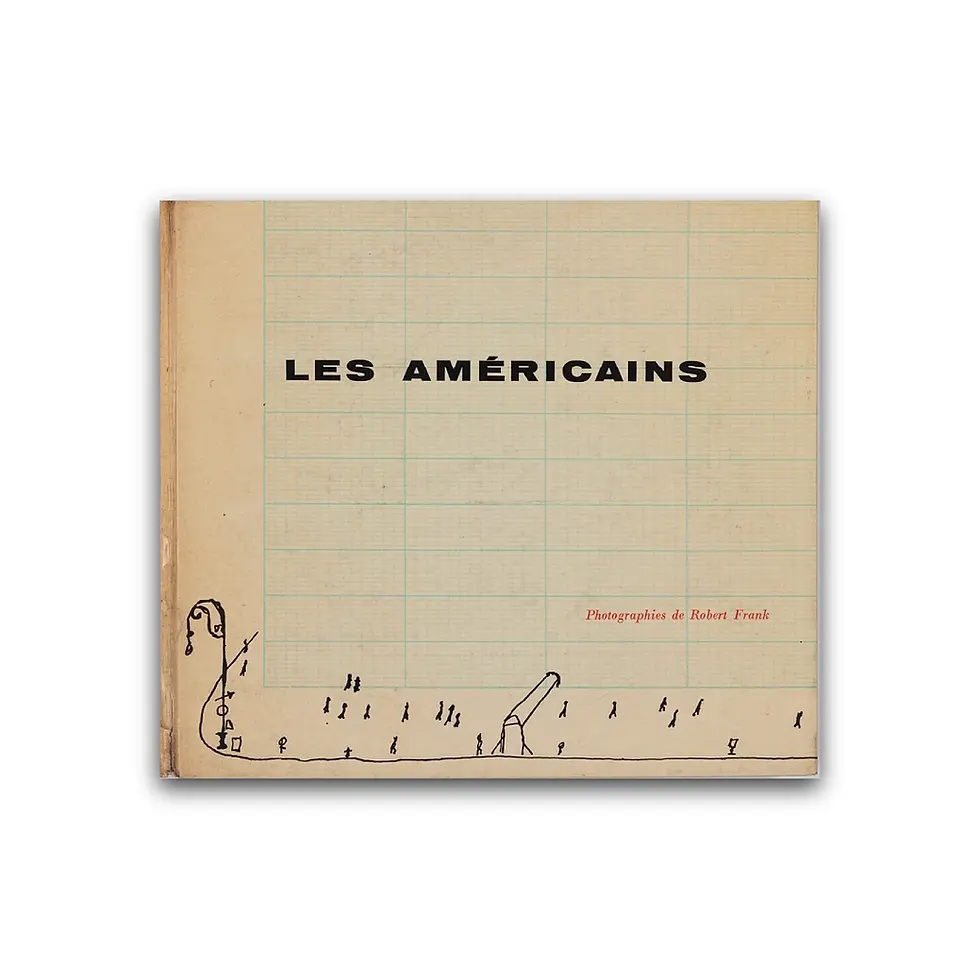
Front cover of the first edition of “Les Américains”
The somewhat naïve drawings on the cover were created by Saul Steinberg, the cartoonist for the New York-based magazine The New Yorker. Years later, Steinberg would also collaborate with Inge Morath on another great photobook, “Masquerade.”

But there is a fundamental difference with respect to what we understand today by The Americans.
The photographs were not accompanied by Jack Kerouac's text. Instead, Delpire and Alain Bosquet created a book in which Frank's photographs were presented alongside texts about the United States written by various authors.
Among them were Simone de Beauvoir, Erskine Caldwell, William Faulkner, Henry Miller, and John Steinbeck.
The texts appeared facing the photographs, establishing a constant dialogue between image and word.
This radically changes the way you read the book.
The French edition can be understood, in a way, as an interpretation of the United States constructed through the confrontation between literature, history, politics, and photography. Frank's images function almost as visual evidence against an entire literary and cultural tradition that had attempted to explain and define American society.
And here we find one of the fundamental differences between the first two editions.
The French one has a much more sociological character.
The American one will be much more poetic.
The rejection in the United States
And here we come to a part of the story that is often oversimplified.
It's not exactly true that "no American publisher wanted to publish the book because they all rejected it." The reality was much more complex.
Frank had significant difficulty finding a publisher in the United States because his photography did not fit the prevailing expectations of the time. His photographic style was considered by some to be technically deficient, and above all, the image of America he was constructing was unsettling.
American photography in the mid-1950s was heavily influenced by a documentary tradition in which clarity, composition, precision, and technical quality played a fundamental role.
Frank seemed to deliberately defy many of those conventions.
And he wasn't just questioning the formal rules of photography. He was also showing a very different America from the optimistic and prosperous image that prevailed in American culture at that time.
When the project finally found a way to be published in the United States through Grove Press, the initial reaction was particularly harsh.
One of the best-known reviews appeared in Popular Photography.
Editors openly questioned Frank's technique, describing his photographs as blurry, grainy, poorly exposed, and sloppy. But the criticism wasn't limited to purely photographic issues. It also questioned the very vision of America that Frank was presenting.
The underlying accusation was that the photographer presented an excessively negative and unfair image of the country.
In other words: the problem wasn't just that Frank was taking "bad" photographs.
The problem was that he was photographing the United States "badly".
1960 Grove Press and Barney Rosset
The American publication was eventually taken over by Grove Press, the publishing house run by Barney Rosset.
Grove Press was a publisher much more open to experimental literature, counterculture, and those authors and projects that might be uncomfortable for the big conventional publishers.
It was, therefore, a much more suitable context for Frank's work.
But the American edition introduced a radical editorial transformation.
The French texts used by Delpire disappeared.
Instead, an introduction written by Jack Kerouac appeared.
And this is fundamental.
Kerouac was no ordinary writer.
She was one of the central figures of the Beat Generation and represented precisely that other America: nomadic, nonconformist, free and deeply removed from the values of the dominant culture.
Frank had met Kerouac in New York in 1957 and shown him his photographs. Kerouac was deeply impressed by the work and ended up writing the introduction to the American edition.
His participation transformed the context of the book.
We were no longer dealing with a European sociological interpretation of the United States.
Now we had the gaze of a foreign photographer on American society accompanied by the words of one of the most representative writers of the new American culture.
And that completely changed the nature of the book.
The problem of blank pages
Another key editorial decision was to remove the texts that accompanied the photographs in the French edition without replacing them with new texts that contrasted with the images.
The photographs thus became much freer.
The space on the page acquired enormous importance and the images began to relate to each other in a much more direct way.
Small texts or captions associated with certain photographs were also incorporated.
The result was much more radical.
In Delpire's edition, the photographs established a permanent dialogue with historical and literary texts.
In the American edition, the photographs could practically stand alone before the reader.
The difference is enormous.
And that's why it's so interesting to physically compare the first two editions.
They are two different books built from the same 83 photographs.
The French edition attempts to contextualize and explain America.
The US edition allows Frank to suggest it.
The American publication
Here we find another particularly interesting bibliographic detail.
For a long time, 1959 has been cited as the year of publication of the first American edition. Traditional bibliographies usually place it in that year.
However, the Robert Frank Foundation indicates that, although the book was prepared with a publication date of 1959, its actual publication did not take place until January 1960.
That is why we can find examples and bibliographic references cataloged as:
The Americans, New York, Grove Press, 1959.
And also documentation that places its effective publication in 1960.
When it comes to cataloging a specific copy, it is essential to study its bibliographic and physical characteristics, including the colophon, cover, dust jacket, and other elements that allow us to determine exactly what state or printing it is.
83 photographs that changed photography
The final selection of 83 photographs constitutes one of the great photographic editing operations of the 20th century.
Frank had produced around 27,000 photographs.
Only 83 survived the selection process.
But what is truly extraordinary is not just the number of discarded images.
This is how the remaining 83 photographs were organized.
The sequence is fundamental.
The Americans is not a photo album.
Nor is it simply a compilation of the "best images" taken during the trip.
It is an open narrative.
One photograph changes the way we interpret the next.
A character can find a visual echo in another image.
A flag can transform the meaning of a previous scene.
A car can establish a connection between two completely different places.
A face that appears cheerful in a photograph can take on a completely different dimension when it appears next to another image.
Frank understood something that would later become fundamental to the history of the photobook:
The meaning of a photograph can change depending on the photograph that precedes it and the one that follows it.
This conception of the sequence would have an enormous influence on later generations of photographers and editors.
In fact, it is difficult to imagine much of the history of the contemporary photobook without The Americans.
The last photograph
The sequence ends with a particularly significant image: Frank photographing his wife Mary and their children inside a car.
It is an intimate photograph that departs from the apparent documentary objectivity present in much of the rest of the book.
After traveling across the United States from coast to coast, Frank ends up returning to his own family.
The external journey ends up becoming an internal journey.
And this helps to understand why The Americans was never simply a sociological study of the United States.
Frank was photographing a country, but he was also photographing his own experience as a foreigner within that country.
The book is, at the same time, a portrait of the United States and a kind of indirect self-portrait of its own author.
The initial reception: a failure
And here we find another of the great paradoxes of The Americans.
The book was not immediately recognized as the masterpiece we consider it to be today.
On the contrary.
Its initial reception was quite negative.
Critics questioned his technique, his compositions, and the supposedly negative view he presented of the country. Popular Photography was particularly harsh on Frank's work.
Initial sales weren't particularly good either.
The Americans did not immediately become the phenomenon we know today.
Kerouac's introduction helped to spark interest in certain cultural and literary circles, but widespread recognition of the work would still take a few years to arrive.
And perhaps this is precisely what makes the story of The Americans even more extraordinary.
One of the most influential Photography Books in history began its journey being considered, by many, a technically flawed, awkward and difficult-to-understand book.
Over time, those very characteristics that were initially used to attack him would end up becoming some of the fundamental reasons for his importance.
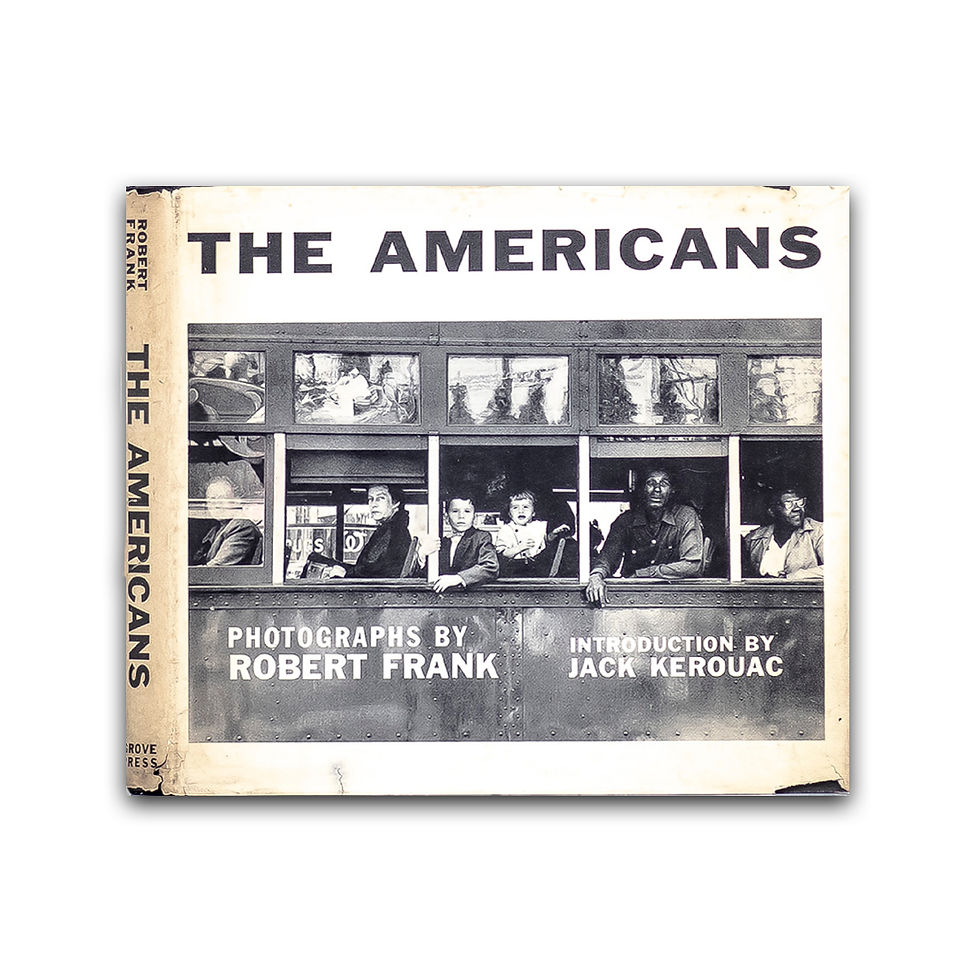
First American edition of The Americans, published by Grove Press in 1960 but dated 1959.
And this is important for understanding the story.
The Americans was not a book that the world immediately recognized as a masterpiece.
It was a book that needed time.
The photograph was changing.
And Frank was ahead of that change.
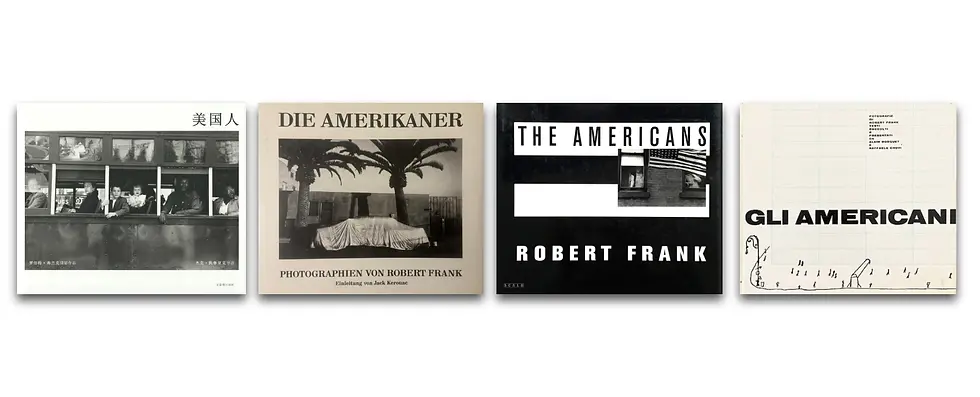
Some of the most sought-after editions of The Americans.


Comments