Fan Ho: The Photographer Who Turned Hong Kong into a Stage of Light and Shadow

Fan Ho: The Photographer Who Turned Hong Kong into a Stage of Light and Shadow
During the 1950s and 1960s, Fan Ho created one of the most distinctive photographic visions of old Hong Kong. His images reveal a city of narrow alleyways, street vendors, markets, workers, children, bicycles, boats and weathered buildings, but reducing his work to a document of a vanished city would tell only part of the story. Fan Ho used what he encountered in the streets as raw material for meticulously constructed images in which geometry, shadows and, above all, light transformed everyday situations into small cinematic scenes.
Born in Shanghai in 1931, Fan Ho became interested in photography as a teenager. His first experiments were made with a simple Kodak Brownie, until his father gave him a medium-format Rolleiflex that would become inseparable from his most important years as a photographer. When his family moved to Hong Kong in 1949, Fan Ho found himself in a city undergoing an enormous transformation.
Hong Kong was receiving a huge influx of people from mainland China and was still far removed from the vertical, financial metropolis we know today. Its streets were crowded with small shops, vendors, dockworkers, rickshaw drivers and families trying to make their way in a city where space was becoming increasingly scarce. Old neighbourhoods coexisted with rapidly accelerating modernisation, and the tension between these two worlds provided Fan Ho with the setting in which he would develop almost his entire photographic language.
While much of Hong Kong’s commercial photography remained tied to the studio, Fan Ho preferred to walk through the city. He explored markets, docks, working-class neighbourhoods and alleyways, observing how people interacted with these spaces. He did not seem particularly interested in creating an inventory of buildings or monuments. What attracted him was everyday life: children returning from school, vendors waiting for customers, workers crossing a street, people pushing carts or a solitary figure disappearing at the end of an alley.
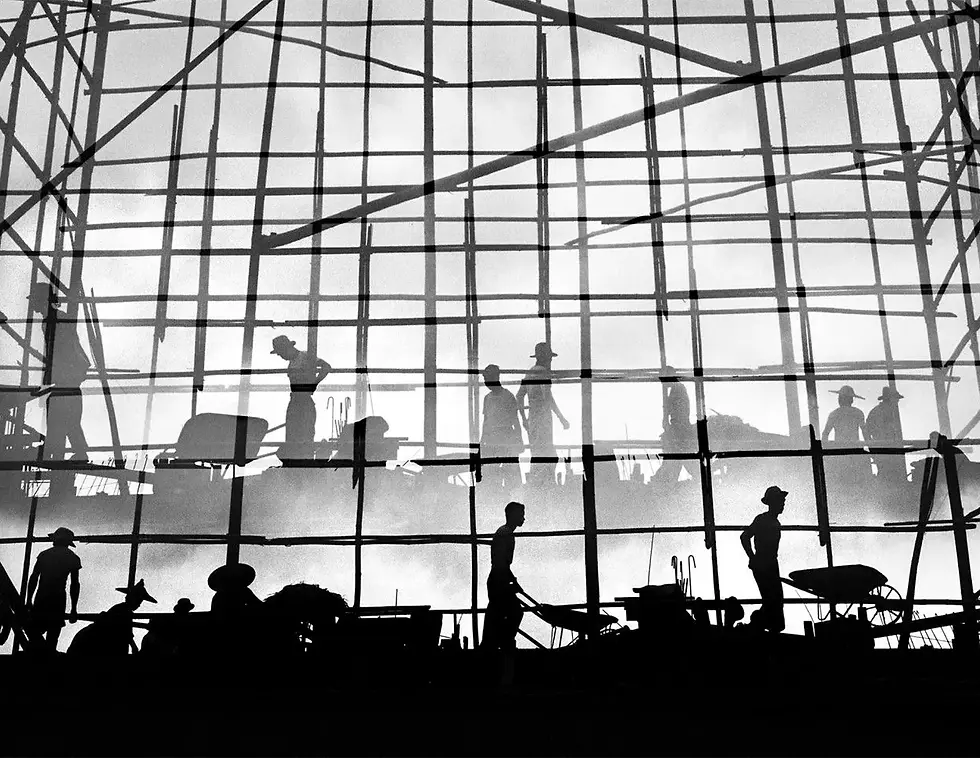
In his photographs, these apparently insignificant situations acquired another dimension. A person might appear precisely inside a triangle of light while a shadow cut diagonally across the frame; a staircase divided the photograph into different planes, or a tiny human silhouette became surrounded by enormous areas of darkness. The result often appears extraordinarily calculated because, to a considerable extent, it was.

LEARNING TO SEE WITHOUT A SCHOOL
Fan Ho was essentially self-taught. He learned by experimenting with the camera, exposure, developing and printing, initially even using the bathroom of the family home as an improvised darkroom. Yet technique never seems to have been the ultimate purpose of his photography. His real obsession was learning how to organise whatever appeared in front of the camera.
His method could be remarkably patient. He would first find a location offering interesting visual possibilities, study the architecture and observe how the light entered the space. Then he would wait until someone appeared in exactly the right place. The street stopped functioning simply as a setting for everyday life and began to behave like a stage on which Fan Ho waited for his character to arrive.
This way of working explains the remarkable precision of many of his photographs. People always seem to occupy exactly the right position within the frame, but behind that apparent coincidence lay an extraordinary ability to observe. Fan Ho had learned to anticipate the movement of the city and recognise the moment when its different elements could briefly align to form an image.

WHEN LIGHT BECOMES THE TRUE PROTAGONIST
Defining Fan Ho simply as a street photographer is insufficient. His photography is deeply connected to geometry, architecture and, above all, the way light can transform a space.
The Hong Kong that appears in his photographs is constructed from diagonals, staircases, walls, reflections, mist, smoke and vast areas of darkness. People remain essential, but they often occupy only a tiny proportion of the image. Their presence provides scale and tension to spaces that, without the human figure, could easily become abstract compositions.
Fan Ho was particularly drawn to moments when sunlight penetrated between buildings and created sharply defined beams. Humidity, smoke and pollution suspended in the streets made these rays even more visible. A person could therefore appear almost completely surrounded by darkness while a small illuminated area marked the precise point through which they were walking.
Geometry never becomes a purely formal exercise because something is always happening within it. A bicycle crosses the composition, someone descends a staircase or a solitary figure appears in the distance. These small human events prevent the photographs from losing their connection with the street.
APPROACHING SHADOW: A SHADOW THAT NEVER EXISTED
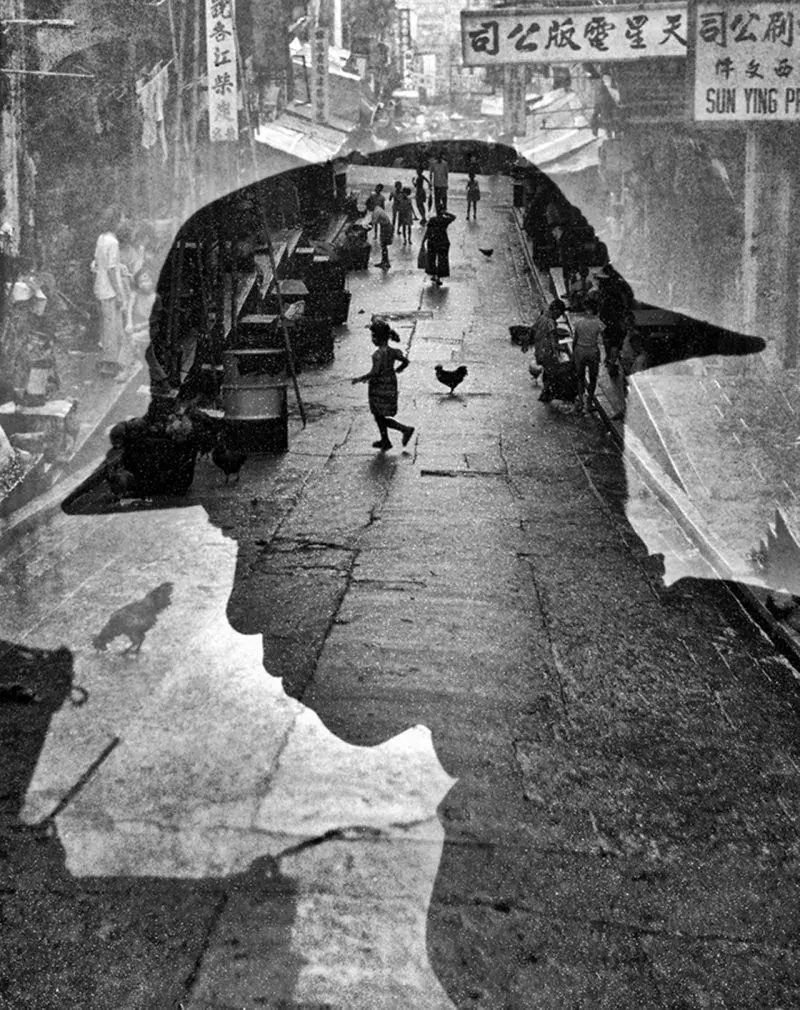
Approaching Shadow, made in 1954, is probably one of the photographs that best reveals Fan Ho’s way of working. The image shows a woman standing beside a wall while an enormous triangular shadow appears to advance towards her. The composition is reduced to only a few elements, and precisely because of this it possesses extraordinary visual power.
It would be easy to imagine Fan Ho waiting for hours until the sun projected that exact shape onto the wall, but the photograph contains a deliberate construction. The woman was the photographer’s cousin, whom he asked to pose, while the enormous diagonal shadow was added later during the darkroom process. Fan Ho explained that the dark mass was connected to the passage of time and the inevitable disappearance of youth.
This detail is fundamental because it dismantles the idea of Fan Ho as a photographer exclusively devoted to capturing spontaneous moments. For him, photography was not necessarily obliged to reproduce literally what had happened in front of the camera. The negative could be altered and reality reorganised until it matched the image he had imagined.
This freedom to move between document and fiction would repeatedly appear throughout his work and eventually connect photography with another of the great obsessions of his life: cinema.
THE PHOTOGRAPHER WHO WANTED TO MAKE FILMS
The relationship between Fan Ho’s photographs and cinematic language is not merely a later interpretation of his work. Fan Ho wanted to work in film, and in 1961 he joined Shaw Brothers, one of the most important studios in the Asian film industry.
He initially worked in continuity and later developed a career as an actor, appearing in numerous studio productions. In time, he left Shaw Brothers to direct his own films and developed an extensive cinematic career between Hong Kong and Taiwan.
For many years this aspect of his career even overshadowed his photography. In Hong Kong, a large part of the public knew him as an actor and director before recognising him as the author of the photographs that would later achieve international acclaim.
Knowing this also changes the way we look at his photographs. Many seem to contain a narrative compressed into a single frame. Characters enter and leave spaces carefully defined by architecture and light, yet we do not know what happened immediately before or what will happen next. Fan Ho allows us to see only that intermediate moment, forcing us to imagine the rest of the story.

HONG KONG AS A GREAT THEATRE
The idea of the city as a stage appears constantly throughout his work and perfectly explains the title of one of his essential books, The Living Theatre. For Fan Ho, Hong Kong functioned as a continuous performance in which people involuntarily became characters and any market, harbour, staircase or alleyway could be transformed for a few seconds into a stage.
Yet this visual dimension should not make us forget the social conditions visible in his photographs. Fan Ho portrayed a city in which a significant part of the population lived under difficult circumstances. His images are filled with manual workers, street vendors, families living in confined spaces and children playing in poor neighbourhoods.
However, he rarely turns these conditions into spectacle. There is a notable absence of sentimentality. Poverty forms part of the environment, but his subjects retain a powerful presence within the photographs. Fan Ho seems more interested in observing how people inhabited and transformed these spaces than in using them as symbols of a particular social condition.
This is precisely why his photographs have acquired a documentary value over time that probably exceeded his original intentions. Many of the places he photographed were subsequently demolished or completely transformed. Markets disappeared, neighbourhoods changed, the harbour was modernised and vertical architecture radically altered the scale of Hong Kong. The photographs made by a young man simply walking through the city in search of images eventually became a visual archive of a vanished world.

THE DECISIVE MOMENT, BUT ON HIS OWN TERMS
Fan Ho has frequently been compared with Henri Cartier-Bresson because of his extraordinary ability to organise different elements within a fraction of a second. Yet the comparison can be misleading if it leads us to assume that both photographers understood photography in the same way.
Fan Ho maintained a much more flexible relationship with the supposed purity of the photographic instant. He could wait patiently for a situation to unfold spontaneously in front of the camera, but he could also direct a person, radically crop an image or alter light and shadow during printing. Decades later, he would even combine different negatives from his archive to create photographs that had never existed as a single real moment.
For Fan Ho, the negative did not necessarily represent the end of the process. It could simply be the raw material from which the final photograph was constructed.
This makes his work particularly interesting from a contemporary perspective. Long before digital manipulation turned such questions into a permanent debate, Fan Ho was already working comfortably within the ambiguous territory between document, memory and construction.

THE STRANGE SILENCE OF HONG KONG
It is striking that such a densely populated and noisy city can appear so silent in Fan Ho’s photographs. Much of this effect comes from his use of empty space and his tendency to isolate people within the frame.
In many images, a single figure occupies only a small part of a composition dominated by architecture. A man walks towards a dark area, someone disappears at the end of a street or a bicycle briefly crosses an illuminated surface. The human scale seems tiny in relation to buildings, walls and shadows.
This distance introduces a feeling of solitude that repeatedly appears throughout his work. The photographs clearly belong to mid-twentieth-century Hong Kong, yet they also speak about something much more universal: the relationship between the individual and a city growing and changing at a speed that is difficult to control.
Perhaps this is one reason why his images have aged so remarkably well. We do not need to have known that Hong Kong personally to understand the feeling they convey.
AN ARCHIVE CREATED IN HIS YOUTH
A surprisingly large proportion of the photographs for which Fan Ho is known today were made while he was still very young. The essential core of his work belongs to his adolescence and, above all, his twenties. Before reaching the age of thirty, he had already produced many of the images that would establish his international reputation decades later.
His photography did not go entirely unnoticed at the time. Fan Ho participated extensively in international photographic salons and accumulated a considerable number of prizes and distinctions. Between the late 1950s and the first half of the 1960s, his name repeatedly appeared within international art photography circles.
Cinema then began to occupy an increasingly important place in his professional life and his photographic production gradually receded from view. The negatives remained stored away for decades while Fan Ho pursued another career.
Those same negatives would eventually lead to his second life as a photographer.
THE RETURN TO HONG KONG
Decades later, photographs of Hong Kong from the 1950s and 1960s began attracting renewed attention from galleries, collectors, publishers and photographers. Fan Ho returned to his archive and started examining negatives made half a century earlier.
What makes this particularly interesting is that he did not simply reprint his best-known photographs. He looked at the archive again with different eyes. He discovered images he had previously rejected, created new crops and even began combining separate negatives to construct new compositions.
The older photographer began, in a sense, to collaborate with the young man who had wandered through Hong Kong carrying a Rolleiflex decades earlier. The archive stopped functioning merely as a repository of the past and became creative material once again.
This rediscovery produced some of the Photography Books that are now essential for understanding his work. Hong Kong Yesterday appeared in 2006, The Living Theatre in 2009 and A Hong Kong Memoir in 2014. Portrait of Hong Kong followed later, a project developed during the final years of his life and completed with the help of his family after his death.
These books were fundamental in shaping the contemporary perception of Fan Ho and also explain why his work now occupies such an interesting position within the world of Collectible Photobooks and twentieth-century Asian photography.
HONG KONG YESTERDAY
Published in 2006, Hong Kong Yesterday became a crucial part of Fan Ho’s international rediscovery. The book brings together much of the visual universe now associated with his name and allows us to explore the Hong Kong he photographed during his youth.
What makes the images particularly interesting is that they were not created out of nostalgia. Fan Ho was not returning to a lost city when he made them; he was discovering a city changing in front of him. Nostalgia came later, when the buildings, streets and ways of life contained within those photographs began to disappear.
Hong Kong Yesterday therefore functions simultaneously as a photographic work and a time capsule. For anyone interested in Photography Books capable of combining an extraordinarily distinctive visual identity with historical documentation, it is probably the most immediate entry point into his work.
THE LIVING THEATRE
The Living Theatre develops Fan Ho’s relationship with people even more clearly. Hong Kong appears as a permanently active stage where markets, streets, docks and alleyways continuously produce small stories.
The title perfectly summarises his way of observing the city. Fan Ho did not need to invent dramatic events because the spectacle was already unfolding in front of him. His task was to recognise the moment when people, architecture and light could converge within a single composition.
It is also one of the books that best reveals the connection between his photography and cinema. Each image seems to belong to a larger narrative that remains outside the frame.
A HONG KONG MEMOIR
A Hong Kong Memoir introduces an important change because Fan Ho is no longer working only with the Hong Kong he photographed, but with the memory of that city.
While reviewing his old negatives, he began producing new interpretations, combinations and superimpositions. The archive becomes a form of visual memory in which different moments can coexist within a single image.
This approach is particularly appropriate for a book devoted to memory. Our own memories do not reproduce the past literally either. They mix places, people, situations and moments separated by time. Fan Ho uses his negatives in a similar way, allowing photographs made decades earlier to generate new images.
Among his photobooks, A Hong Kong Memoir is probably one of the projects that most clearly demonstrates that his return to the archive was not simply nostalgic. Fan Ho continued to use those photographs as creative material.
PORTRAIT OF HONG KONG
Portrait of Hong Kong inevitably feels like a farewell. During the final years of his life, Fan Ho once again reviewed hundreds of negatives from his street photography period with the intention of constructing a broader portrait of the people who had inhabited the city.
The project remained unfinished when Fan Ho died in California on 19 June 2016, aged 84. His family, particularly his daughter Claudia, later helped complete the book by following the work and selections he had already prepared.
The journey becomes almost circular. A young man born in Shanghai arrives in Hong Kong, discovers the city while walking with a Rolleiflex, gradually leaves photography behind to devote himself to cinema and, more than half a century later, eventually returns to those same streets through his negatives.
THE REAL CITY AND THE INVENTED CITY
The great paradox of Fan Ho lies precisely in the fact that his work constitutes one of the most fascinating visual records of mid-twentieth-century Hong Kong while, at the same time, he never intended merely to reproduce that reality faithfully.
Fan Ho photographed an existing city but reorganised it through framing, waiting, light, darkroom work and, whenever he considered it necessary, manipulation of the image itself. A staircase could stop being simply a staircase and become a geometric structure; an illuminated wall could turn into an abstract stage, while an anonymous worker could become, for a fraction of a second, the protagonist of a film that was never made.
Much of the enduring power of his photography can be found here. We can look at his images as historical documents of old Hong Kong, study them within the tradition of street photography or approach them for their extraordinary visual construction. His finest photographs allow all these readings to coexist.
Fan Ho understood very early that a camera could record the world while simultaneously transforming it. During his years walking through Hong Kong, he turned crowded streets, markets, docks and working-class neighbourhoods into an immense stage constructed through light, geometry and human presence.
The Hong Kong he encountered when he arrived in 1949 has almost completely disappeared. The one he created within his photographs continues to exist. Ho: el fotógrafo que convirtió Hong Kong en un escenario de luz y sombras