Jonas Bendiksen the Satellite Hunter

Satellites, by Jonas Bendiksen: life on the margins of the Soviet Union
When the Soviet Union officially dissolved in December 1991, so did the political system that had shaped the lives of millions for decades. The fifteen Soviet republics embarked on different paths to independence, but the collapse left behind a far more complex geography than the new maps could depict. Separatist territories, disputed borders, abandoned industrial cities, and communities that had severed their economic ties with Moscow were caught in a transition whose outcome no one seemed to know.
In 1998, at just twenty-one years old, Norwegian photographer Jonas Bendiksen began traveling to some of these places. For the next seven years, he explored peripheral regions of the former Soviet Union, documenting a reality that received little representation in Western media. The result was Satellites: Photographs from the Fringes of the Former Soviet Union , published by Aperture in 2006, his first photobook and one of the key works in his career.
The territories that were left off the map
The title Satellites encapsulates much of the project's meaning. During the Cold War, countries and territories under Moscow's influence were frequently described as Soviet satellites. After the collapse of that center of power, many remained economically, culturally, and politically linked to Russia, even though their circumstances had changed radically.
Bendiksen was interested precisely in these spaces of uncertain identity, places where the structures of the past were still present, but the rules that organized daily life had ceased to function.
In Abkhazia, a breakaway region of Georgia on the Black Sea coast, he found a society scarred by the consequences of war and population displacement. Old Soviet-era tourist infrastructure stood alongside dilapidated buildings and communities trying to regain some semblance of normalcy amidst an unresolved territorial conflict.
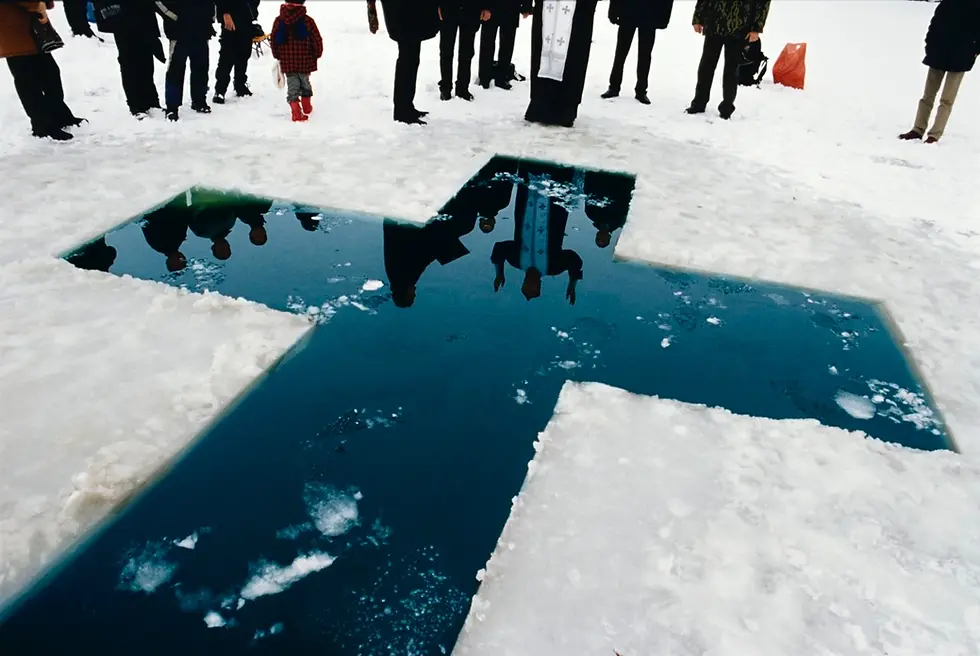
In Transnistria, a narrow strip of territory between Moldova and Ukraine, he photographed a self-proclaimed republic that had preserved numerous symbols and references from the Soviet era. There, the collapse of the USSR seemed to have produced a paradoxical situation: a territory that had been left politically suspended while the rest of Europe moved toward a new configuration.

Other trips took him to Central Asia and Siberia, where the consequences of the collapse took different forms. In Kazakhstan, near the Baikonur Cosmodrome, Bendiksen documented how the inhabitants of some communities made use of the metallic debris from space rockets that fell on the steppes after launches.

The image is particularly significant. The technology that had symbolized Soviet scientific and military power was now being used as salvage by people seeking resources to survive. The ambition to conquer space and the most basic needs of daily life were brought together in the same landscape.
A geography of uncertainty
Although Satellites addresses the consequences of a political event of enormous magnitude, Bendiksen avoids constructing a conventional historical narrative. His photographs do not attempt to exhaustively explain the Soviet disintegration or offer a definitive interpretation of the conflicts that arose afterward.

Instead, it directs attention to the people who continue to live in these territories.
The settings are extraordinarily diverse. They include apartment blocks, factories, mountain landscapes, domestic interiors, and industrial sites where traces of the past coexist with everyday activities. The inhabitants of these places work, rest, celebrate, and socialize in spaces that, seen from the outside, may appear abandoned or frozen in time.
This coexistence of the ordinary and the extraordinary is one of the most interesting aspects of the book. Bendiksen finds situations that might seem absurd, but which respond to very specific historical circumstances. His images show how people develop new forms of adaptation when the economic and political structures that had organized their lives disappear.
The result is a vision of the former Soviet Union that is far removed from both nostalgia and the more conventional representations of its decline.
Color as a form of storytelling
Satellites also allows us to discover the formation of a photographic language that would later become one of Jonas Bendiksen's hallmarks.
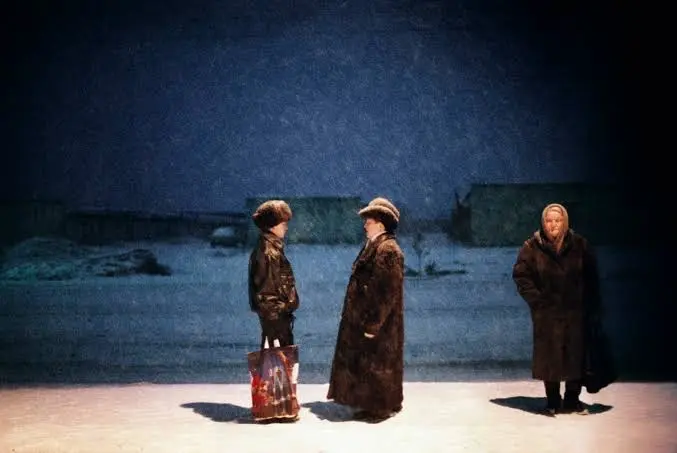
His approach combines documentary observation with meticulous attention to composition, color, and light. The figures frequently appear integrated into visually complex settings, where architectural elements, objects, and landscape all contribute to constructing the image's meaning.
Sometimes, human figures occupy a minimal part of the frame, surrounded by enormous industrial structures or seemingly uninhabited natural spaces. At other times, the photography approaches intimate situations, showing interiors and small gestures that allow us to understand the lives of its subjects from a closer perspective.
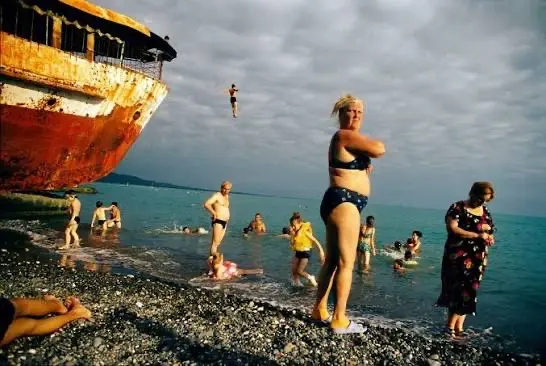
Color plays an essential role. Far from using it merely as a descriptive tool, Bendiksen harnesses its expressive potential to establish relationships between the characters and their surroundings. Natural light, deteriorated surfaces, and chromatic contrasts transform seemingly ordinary scenes into images of remarkable visual intensity.
There is also room for humor and surprise. Some photographs present situations so improbable that they seem carefully staged, even though they stem from real encounters. This ability to recognize the extraordinary within everyday life distinguishes Bendiksen's work from documentary photography focused exclusively on conflict or denunciation.
A photographer in search of his own language
When he started Satellites, Bendiksen was still in the early stages of his career. He had worked as an assistant in Magnum Photos' London office and decided to embark on his own travels to develop an independent photographic practice.
The project became a defining experience. During those years, she learned to approach unfamiliar communities, build relationships with their members, and develop visual narratives from unforeseen situations.
In 2004 he was accepted as a candidate at Magnum Photos and in 2008 he became a full member. Between those two dates, Satellites was published, the book that introduced internationally a way of understanding photography based on the coexistence of documentary rigor and a deeply personal vision.
In his later works, such as The Places We Live , published in 2008, Bendiksen would continue to explore the relationships between people and the spaces they inhabit. However, Satellites retains a particular energy, related to discovery and the freedom of a photographer who was still defining the boundaries of his own work.
Satellites, twenty years later
Published in 2006 by Aperture, Satellites brings together 62 color photographs spread across 152 pages. Its relatively compact format contrasts with the geographical and political scope of the project, encouraging a close reading of the images and the accompanying texts.
Two decades after its publication, the book has acquired a historical dimension that is impossible to separate from subsequent events. Territorial tensions in the Caucasus, the persistence of political entities without international recognition, and the conflicts that continue to affect the former Soviet space have inevitably altered the way these photographs are interpreted.
However, one of the greatest achievements of Satellites is that its images are not solely dependent on the political context in which they were taken. Beyond borders and historical events, Bendiksen constructed a portrait of people trying to find their place in a world that had changed without their consent.
The collapse of the Soviet Union had transformed the maps, institutions, and economies of those territories. But reality could be found at the opposite end of the political spectrum: in a room, on a road, among the ruins of a factory, or in the life of someone who continued to hope for a different future.
Satellites remains one of the most significant photobooks from Jonas Bendiksen's early years and a visual document of a geography that, even after the disappearance of the empire that had organized it, continued to revolve around its ruins.