

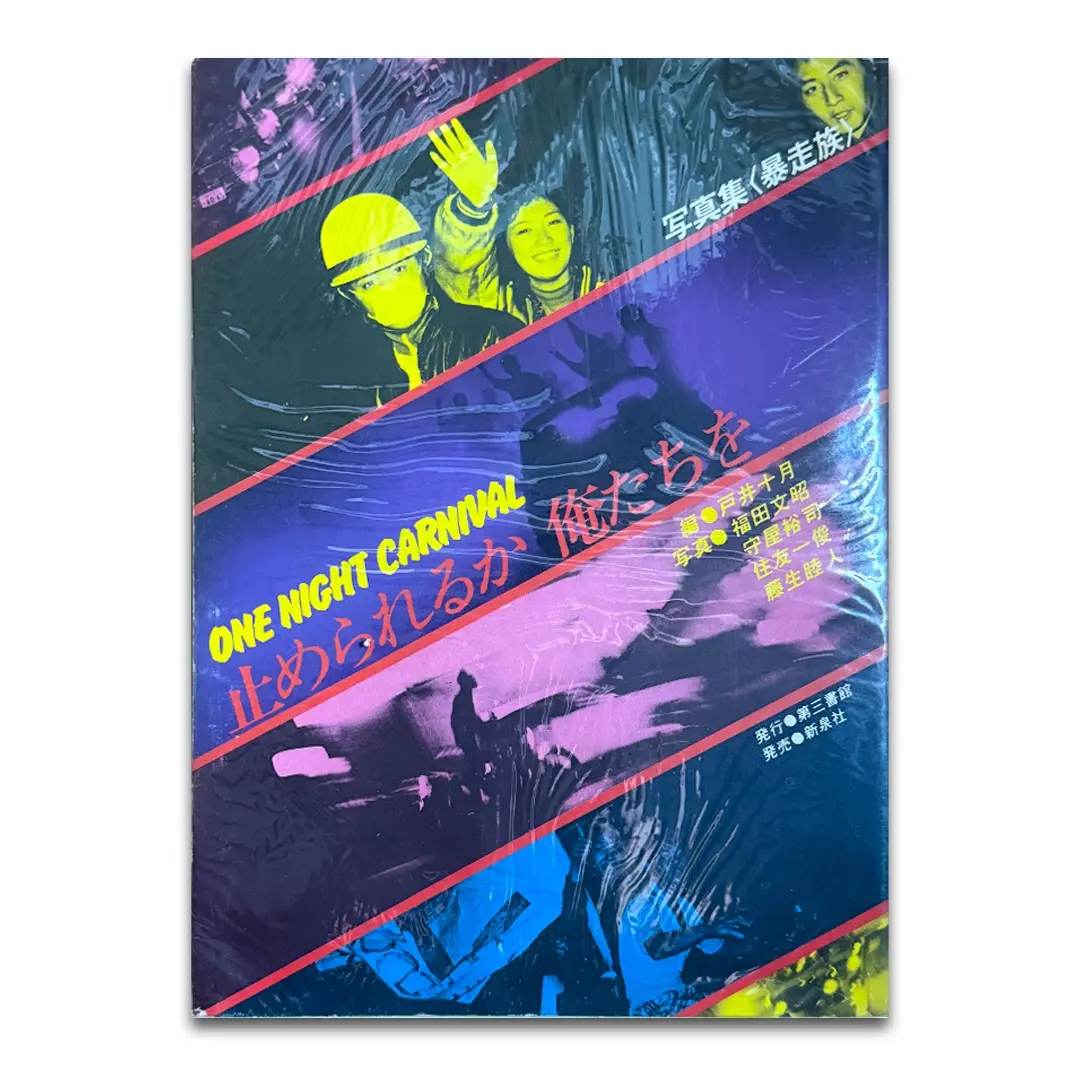

ONE NIGHT CARNIVAL: CAN YOU STOP US? is one of the most fascinating Japanese photobooks devoted to bōsōzoku culture and an exceptional document of a youth subculture that became highly visible in Japan during the 1970s.
Originally published in 1979 by Daisan Shokan under the Japanese title 止められるか、俺たちを, approximately “¿Podéis detenernos?”, the book was conceived and edited by writer and journalist Jūgatsu Toi. It is not, however, the work of a single photographer. The images were taken by Fumiaki Fukuda, Yuji Moriya, Kazutoshi Sumitomo and Mutsuhito Fujio, collectively creating a portrait of the bōsōzoku scene from an unusually close perspective.
The photographs take us straight into the world of these gangs of young motorcyclists: modified motorcycles, uniforms, embroidered jackets, night-time gatherings, roads, lights, smoke and groups who turn their public presence into a form of spectacle. The motorcycle appears as more than a vehicle. It is an extension of individual and collective identity, a machine transformed to stand out while also demonstrating membership of the group.
One Night Carnival avoids reducing its subjects to a simplistic image of juvenile delinquency. In contrast to the sensationalist view through which much of Japanese society then regarded the bōsōzoku, the book approaches them from within. There is defiance and potential violence, but also friendship, pride, their own codes, theatricality and an intense need to belong.
Much of its power comes precisely from this closeness. The photographers do not seem to observe from a distance. Their cameras are inside the gatherings, beside the motorcycles and facing the young people. The portraits allow us to study their hairstyles, gestures, insignia and uniforms, while other images convey the movement and energy of the night-time gatherings.
The very concept of “One Night Carnival” is especially apt. Visually, the gatherings function as clandestine carnivals in which the usual rules seem to be suspended for a few hours. Participants occupy the road and construct an alternative identity through noise, speed, clothing and extreme modifications to their machines. Night transforms urban space into a stage on which they can make themselves visible.
Yet beneath this spectacle there is also a generational portrait. Jūgatsu Toi took an interest in these young people, seeking to understand what lay behind behaviour that outsiders interpreted as simply antisocial. The book suggests a generation seeking recognition and creating its own structures of belonging in opposition to an adult world from which it feels increasingly distanced.
Seen several decades later, One Night Carnival also has immense documentary value. Bōsōzoku culture would evolve considerably in subsequent years, eventually becoming an international visual reference associated with Japan. Many of its aesthetic codes would later be absorbed by fashion, manga, cinema, music and popular culture.
Published precisely when the phenomenon was expanding rapidly, the book preserves something much harder to recreate retrospectively: the feeling of witnessing this culture while it was still unfolding.
For this reason, One Night Carnival occupies a distinctive place among rare Japanese photobooks relating to urban subcultures. It is not simply a photography book about motorcycles. It is a document of youth, collective identity, rebellion and representation, made with a closeness that turns its pages into direct testimony to a scene that would later acquire an almost mythological dimension.
The original 1979 edition is of particular interest to collectors of Japanese photography books and collectible photobooks connected with Japanese subcultures. Beyond its spectacular bōsōzoku imagery, its importance lies in having captured on paper a very specific moment in Japanese youth culture before that aesthetic was reinterpreted and turned into a cultural icon.


