

Subway and Bruce Davidson’s Masterful Use of Color.
- Dartbooks

- 1 day ago
- 5 min read
Bruce Davidson’s Subway project was born in the early 1980s, at a time when the photographer needed to find his way back to a personal project after several years devoted to commercial work and the frustration of a film project that ultimately never came to fruition. Davidson began travelling again through some of the New York neighbourhoods he had photographed before, and he constantly used the subway to get there. Little by little, he began to understand that the journey itself was not simply a way of reaching his destination, but that the subway was an extraordinary microcosm of the city. People from completely different backgrounds, generations, and social classes found themselves sharing the same confined space for a few minutes. The subway thus became the subject he had been looking for.

The decision to work there was not an easy one. The New York subway system of the period had a terrible reputation and was associated with crime, dirt, deterioration, and a strong sense of insecurity. Davidson knew perfectly well that he was entering a potentially dangerous environment and, on top of that, he was carrying cameras, lenses, and flashes that made him highly visible. To prepare himself, he even changed his physical routine. He followed a diet, exercised, and ran in the mornings, partly to build the stamina required to spend long days walking through stations and train cars, and partly to feel prepared for whatever situation might arise. His equipment was also carefully organised. He carried cameras, lenses, film, a flash, maps, passes, and various small items that might prove useful during his long journeys through the network.
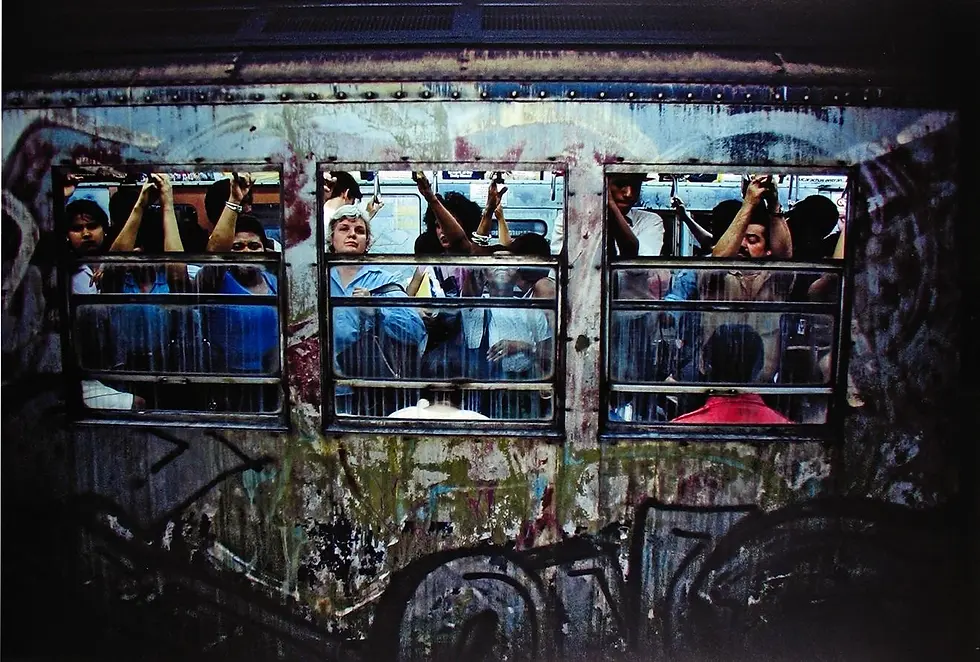
At first, Davidson thought he would make the project in black and white, the language through which he had established much of his career. However, the subway itself gradually convinced him that he needed to work in colour. The graffiti, painted walls, passengers’ clothing, advertisements, train cars, and artificial lighting produced a combination of colours that black and white could not convey. Colour eventually became a fundamental part of Subway’s identity, particularly through his use of flash and films such as Kodachrome. The combination of extremely intense illumination on the subjects and the darkness surrounding them created the project’s distinctive visual character: faces and bodies appearing almost suspended against black backgrounds, metallic surfaces, and huge areas of saturated colour.
The flash also had a much more important function than a purely technical one. Davidson was not trying to remain invisible. On the contrary, the burst of light made his presence immediately apparent inside the train car. Each photograph became a kind of small event. The photographer and the subject entered into a relationship, and in many cases the person knew perfectly well that they were being photographed. Davidson even carried a small album of previous photographs with him so that he could show passengers what he was doing and make it easier for them to agree to be photographed. This way of working explains why so many of the images in Subway convey such an intense sense of encounter. They are not simply photographs taken anonymously and unnoticed, but moments of contact between the photographer and the people he encountered.

For approximately five years, Davidson travelled extensively throughout the subway network, observing its different lines, stations, and atmospheres. There he encountered virtually the entire human spectrum of New York: workers, teenagers, couples, families, homeless people, musicians, apparently dangerous characters, elegant women, children, and members of the Guardian Angels, who at the time voluntarily patrolled the trains in response to growing concerns about safety. Davidson was particularly fascinated by graffiti, which he regarded as a kind of secret language existing alongside the passengers. In some photographs, people seem almost to merge with the inscriptions on the walls and train cars, as if they were part of the same piece of writing.
One of the project’s most important characteristics is precisely that Davidson never wanted to turn the subway exclusively into a stage for violence. Although a sense of threat is present in many of the images, there are also moments of intimacy, humour, sensuality, tenderness, and beauty. A couple embracing, someone asleep, a woman waiting for a train, or a group of young people can possess the same intensity as an apparently dangerous scene. Davidson discovered that the subway could be dark, aggressive, and unpleasant, but also extraordinarily human. Beauty emerged precisely because it existed within that atmosphere of tension.

There are small stories behind some of the photographs that help us understand the way he worked. On one occasion, he saw a woman whose dress was moving in the rush of air created by a passing train. Rather than photographing her furtively, he approached her and asked for permission. She agreed, and Davidson was able to make one of the images he would later remember with particular affection. Stories like this demonstrate that, although Subway may initially appear to be a project built around risk and confrontation, there was a very particular relationship between the photographer and his subjects at its heart.
The project ultimately became much more than a description of the New York subway. It also represented a major transformation in Davidson’s own photography. After working primarily in black and white for years, he confronted colour, flash, and a much more direct and physically intense way of approaching his subjects. The subway forced him to abandon some of his previous certainties and develop a new visual language. The result was a body of work in which colour, darkness, movement, and human presence combine to create an almost cinematic vision of New York.

The first edition of Subway was published by Aperture in 1986 and quickly became one of Davidson’s fundamental bodies of work. Further editions would appear later, bringing back photographs that had not been included in the original book. However, the 1986 Subway remains particularly important because it represents the moment when Davidson succeeded in condensing several years of observation, risk, and human encounters into an extraordinarily coherent sequence.
What is most fascinating about the project is that everything seems to have emerged from a fairly simple need: Davidson needed to return to making photographs that were truly his own. To find them, he had to descend into the subway, confront a place that frightened him, completely rethink the way he worked, and learn to see New York differently. The result was not simply a document of the subway in the 1980s, but one of the great bodies of colour photography of the twentieth century, a project in which a seemingly deteriorated city becomes, through Davidson’s eyes, a landscape filled with tension, mystery, violence, intimacy, and beauty.



Comments